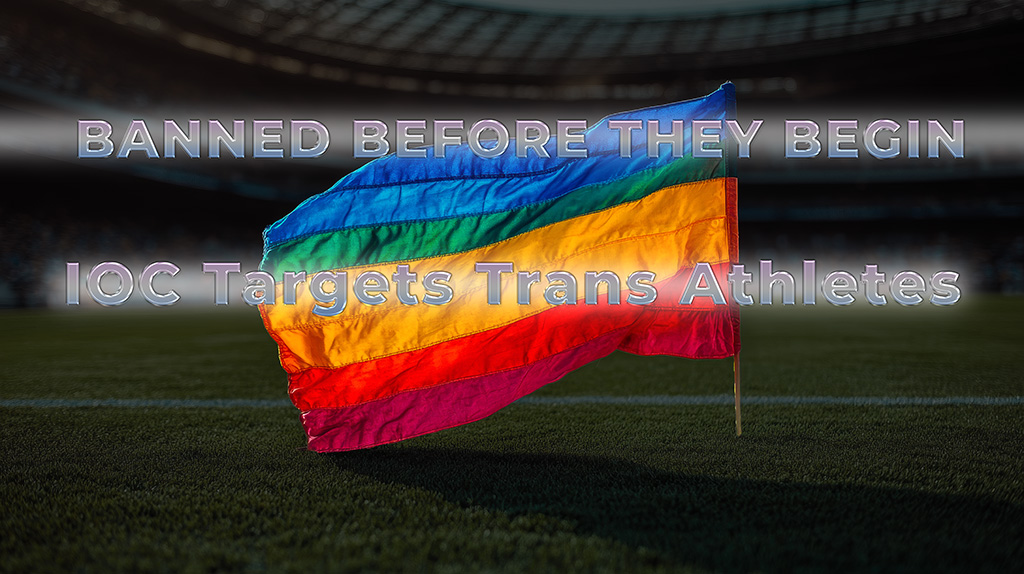
In a move already sending shockwaves through the global sports community, the International Olympic Committee (IOC) is facing fierce backlash after advancing a policy widely interpreted as a ban on transgender athletes from Olympic competition.
While the IOC has framed the shift as an effort to “protect fairness in women’s sport,” advocates, athletes, and human rights organizations say the decision reflects something else entirely: a growing wave of political pressure — and a troubling alignment with policies pushed by the administration of Donald Trump.
A Global Stage, A Narrowing Gate
For years, the IOC maintained a more flexible, science-informed framework that allowed international federations to set their own policies on transgender inclusion. That approach, while imperfect, acknowledged the complexity of gender, biology, and fairness.
This new direction signals a hard pivot.
Though full implementation details are still emerging, early guidance suggests stricter eligibility rules that effectively exclude most — if not all — transgender women from competing in women’s categories. Trans men and nonbinary athletes also face unclear and potentially restrictive pathways.
Critics say the ambiguity is the point.
“This isn’t about clarity,” one advocacy group noted. “It’s about exclusion with plausible deniability.”
The Numbers Tell a Different Story
It’s also worth grounding this debate in reality.
Despite years of political rhetoric framing transgender participation as widespread or dominant, the actual number of openly transgender Olympians is vanishingly small. Only a handful of openly transgender or nonbinary athletes have ever competed in the Games — with Laurel Hubbard becoming the first openly transgender woman in Olympic history at the Tokyo Games.
Athletes like Quinn, who competed as openly nonbinary and won gold with Canada’s soccer team, remain rare exceptions — not evidence of a trend.
In other words, the IOC is not responding to a flood of transgender athletes reshaping competition. It is responding to a phenomenon so rare that it has barely registered statistically on the world’s biggest sporting stage.
Following Washington’s Lead?
The timing of the IOC’s move has raised serious questions.
More Stories from QueerDispatch
Since returning to power, the Trump administration has aggressively targeted transgender participation in sports, pushing federal and international pressure campaigns to redefine eligibility based strictly on sex assigned at birth. These efforts have included threats to funding, diplomatic pressure, and a broader narrative framing trans inclusion as a threat to women’s athletics.
While the IOC operates independently, it does not exist in a vacuum.
The United States remains one of the most powerful stakeholders in global sports — politically, financially, and culturally. With Los Angeles set to host the 2028 Summer Olympics, critics argue the IOC has strong incentive to align itself with U.S. political realities.
That raises an uncomfortable question:
Is this about fairness — or about staying in the good graces of a government willing to weaponize sport?
Athletes Caught in the Crossfire
For transgender athletes, the impact is immediate and deeply personal.
Years of training, qualification pathways, and Olympic dreams now hang in limbo — not because of performance, but because of identity.
Many athletes had already complied with previous IOC-linked standards, including hormone regulations and medical oversight. Under the new direction, those efforts may no longer matter.
“This is not a rule change,” one coach told reporters. “It’s an erasure.”
A Broader Pattern of Exclusion
The IOC decision does not stand alone.
Globally, governments and institutions have increasingly moved to restrict transgender participation in public life — from education to healthcare to sport. The Olympic movement, long positioned as a symbol of unity and inclusion, now risks becoming another front in that cultural rollback.
And for many, that betrayal cuts deep.
The Olympics have always been more than competition. They are a statement about who belongs on the world stage.
Right now, that stage appears to be shrinking.
Final Thought
Let’s be clear about what this moment represents.
When the world’s most visible sporting body sidelines an entire group of athletes, it sends a message far beyond the stadium.
It tells transgender people — especially young athletes watching from the sidelines — that no matter how hard they train, no matter how closely they follow the rules, there may never be a place for them at the highest level.
And when that message aligns this neatly with political power, it stops looking like coincidence.
It starts looking like compliance.
Follow this blog on Mastodon or the Fediverse to receive updates directly in your feed.

Kirstyn Piper Plummer is a Mom, Wife, Photographer, Reporter, IT Administrator and many other things.



Read More
- Court Rejects Anti-Trans Activist’s Appeal After False Claims About Trans Soccer Player
- Australia’s High Court Ends Tickle v. Giggle Appeal, Leaving Trans Discrimination Win Intact.
- Appeals Court Upholds Hamtramck’s Pride-Flag Ban, Calling City Flagpoles Government Speech
- New Mexico Says It Will Use State Money to Keep Gender-Affirming Care Available to Trans Youth
[…] the International Olympic Committee moved to restrict transgender participation, Olympic runner Nikki Hiltz called it something […]