
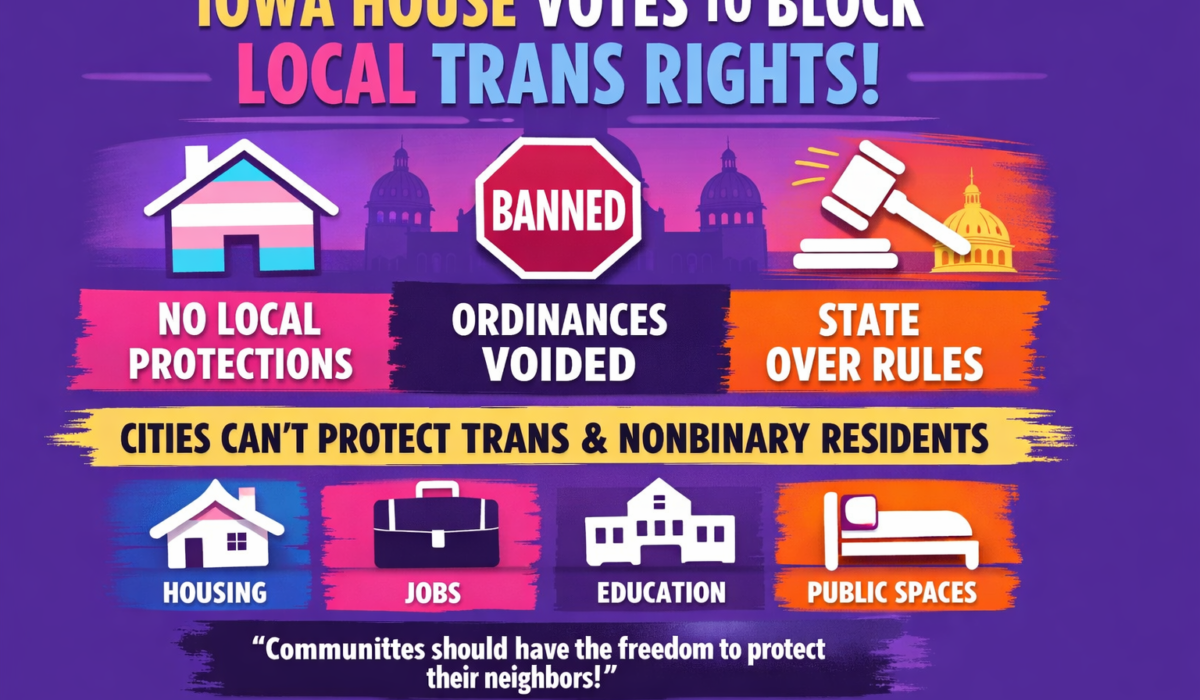
New bill would prevent cities from protecting transgender residents even if communities want to
DES MOINES, Iowa — In a move that LGBTQ advocates say continues Iowa’s rapid rollback of civil rights protections, the Iowa House has passed legislation that would bar cities and counties from enacting anti-discrimination protections stronger than state law—a change that could eliminate local safeguards for transgender and nonbinary residents across the state.
The bill effectively prevents local governments from passing civil rights ordinances that protect groups not recognized under the Iowa Civil Rights Act. Because gender identity was removed from the state’s civil rights law in 2025, the measure would block cities from restoring those protections at the local level.
Civil rights advocates warn the legislation represents a sweeping expansion of state preemption that could erase protections enacted by local communities attempting to shield transgender residents from discrimination.
What the Bill Does
The legislation — an amended version of Senate File 579 — prohibits local governments from adopting ordinances that provide civil rights protections “broader” than those included in state law.
In practical terms, that means:
- Cities cannot pass nondiscrimination laws protecting transgender or nonbinary people
- Local civil rights codes must mirror state law exactly
- Complaints involving local governments may be redirected to the state’s Office of Civil Rights instead of local commissions
Supporters of the measure argue it will create “consistency” across the state’s civil rights framework. However, critics say that consistency is being achieved by forcing communities to remove protections rather than allowing them to expand them.
A Direct Response to Local Pushback
Importantly, the bill comes after several Iowa cities attempted to preserve protections for transgender residents following last year’s sweeping state-level rollback.
For example, Ames recently passed a local ordinance banning discrimination based on gender identity in housing, employment, and public accommodations.
Local leaders framed those actions as an attempt to protect residents after Iowa became the first U.S. state to remove gender identity from its civil rights code in 2025.
However, if the new legislation becomes law, those local protections could be invalidated.
“This is an enhanced civil rights removal act.”
— Iowa Rep. Aime Wichtendahl, criticizing the bill during debate.
A Continuing Legislative Campaign
The new bill is widely seen as part of a broader legislative push targeting transgender rights in Iowa.
More Stories from QueerDispatch
Over the past several years, lawmakers have passed or advanced measures that:
- Restrict gender-affirming healthcare for minors
- Limit discussion of gender identity in schools
- Redefine sex in state law based on biological characteristics
- Remove gender identity from the state’s civil rights protections
Taken together, advocates say the policies form a coordinated effort to systematically strip protections from transgender Iowans across multiple areas of life.
The Stakes for Trans and Nonbinary Iowans
Without local civil rights protections, transgender residents may have fewer legal options when facing discrimination in areas such as:
- Housing
- Employment
- Education
- Public accommodations
These were once covered under Iowa’s civil rights law before the legislature removed gender identity protections in 2025.
For many LGBTQ advocates, the new legislation represents a troubling escalation.
Instead of simply reducing statewide protections, they argue, lawmakers are now attempting to prevent communities from protecting their own residents.
“Communities should have the freedom to protect their neighbors,” one advocate said during protests earlier in the session.
What Happens Next
Because the House amended the legislation, it now returns to the Iowa Senate for further consideration before it can be sent to the governor’s desk.
If signed into law, the bill could immediately invalidate or override local ordinances designed to protect transgender and nonbinary residents.
For LGBTQ advocates, the fight is likely to shift to the courts — and to local communities determined to resist the rollback of protections.