
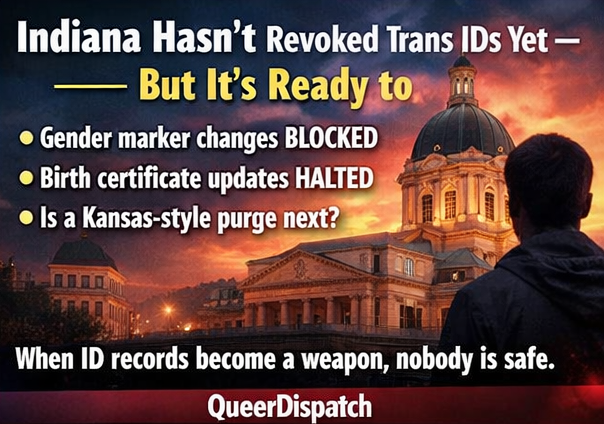
ndiana has not publicly carried out a Kansas-style mass invalidation of transgender people’s identification — at least not yet.
But that is not a reason to relax.
It is a reason to pay attention.
Because when a state blocks transgender people from correcting their documents, defines sex in rigid ideological terms, and reportedly keeps track of who has already updated those documents, it does not take much imagination to see where that road could lead.
Kansas already showed the country exactly what comes next when anti-trans officials decide they are done pretending these policies are about “clarity” or “procedure.”
They become tools for forced outing, humiliation, and legal vulnerability.
“An ID is not just paperwork. It’s the difference between moving through the world safely — or being forced to explain yourself at every door.”
Indiana Has Already Shut the Door on ID Corrections
Indiana has already laid major pieces of that groundwork.
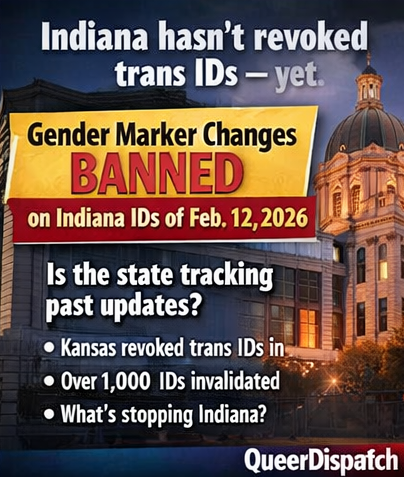
The Indiana Bureau of Motor Vehicles states that as of February 12, 2026, the agency will no longer allow people to change the gender marker on an Indiana driver’s license or identification card using either a physician’s letter or court order.
That means transgender Hoosiers who once had a pathway to correct their identification no longer do.
The policy change is part of a broader shift driven by Mike Braun, whose Executive Order 25-36 directs Indiana agencies to treat sex as a fixed biological classification.
The effect is clear.
More Stories from QueerDispatch
Transgender people are being forced to carry documents that may no longer reflect who they are.
And every mismatch between identity and documentation creates risk — from housing discrimination to employment barriers to dangerous encounters with law enforcement.
The Question That Should Worry Everyone
Recently, new reporting has raised an even more troubling possibility.
According to reporting cited by LGBTQ Nation, Indiana has reportedly flagged or tracked requests for gender-marker changes within state systems and forwarded some cases to the office of Todd Rokita.
If that reporting is accurate, it means the state may already possess the administrative records needed to identify people who previously updated their gender markers.
That does not mean Indiana has already begun rescinding those IDs.
But it does mean the infrastructure could exist to do so.
And that matters.
Because another state has already shown exactly what happens next.
Kansas Already Crossed the Line
Earlier this year, Kansas invalidated the driver’s licenses and birth certificates of more than 1,000 transgender residents after a new law mandated that state documents reflect sex assigned at birth.
People whose identification had previously been corrected were suddenly told those documents were no longer valid.
They were forced to replace them.
They were forced to pay for those replacements.
And they were forced to carry identification that no longer matched their lives.
Advocates warned the policy would dramatically increase the risk of harassment, discrimination, and violence.
“When a government deliberately makes someone’s identification inaccurate, it isn’t protecting truth. It’s manufacturing vulnerability.”
The Pattern Is Already Visible
Indiana’s policies are part of a growing national strategy aimed at erasing legal recognition of transgender people.
First, states restrict healthcare.
Then they restrict school participation.
Then they restrict documentation.
And once documentation is controlled, the state gains enormous power over how — and whether — people can move through society safely.
Indiana may not have carried out a Kansas-style purge yet.
But the policy architecture that made Kansas possible is already visible.
This Is Not Just About Paperwork
An ID card is not just a piece of plastic.
It is the key to renting an apartment.
It is the key to boarding a plane.
It is the key to proving who you are when police ask questions.
When governments deliberately make those documents less accurate for transgender people, the goal is not clarity.
The goal is control.
And if Indiana truly is keeping track of who changed their documents in the past, the question everyone should be asking is simple:
Why?
Because states rarely build bureaucratic systems they don’t intend to use.
Indiana may not have pulled a Kansas yet.
But nobody should ignore how prepared it looks to try.
Editor’s Note
While QueerDispatch could not independently verify from official Indiana publications that the state is currently rescinding previously updated transgender IDs, Indiana has already blocked gender-marker changes on state credentials and birth certificates, and recent reporting suggests that state systems may track prior amendment requests.
[…] This isn’t labeled as “tracking.”But in practice, it requires building a dataset of people whose gender identity differs from their assigned sex. […]