
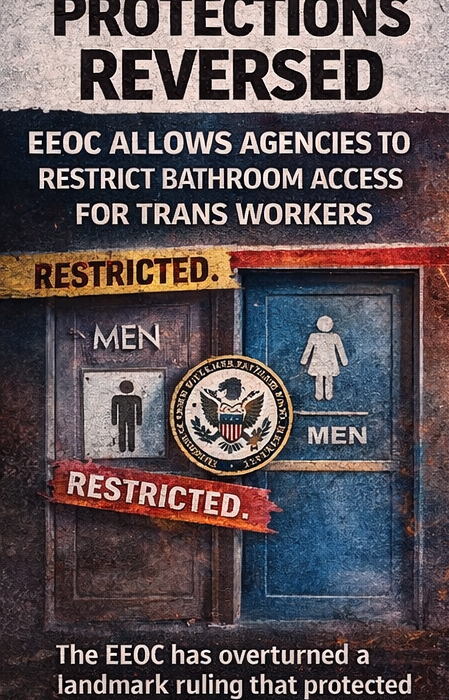
In a major shift for federal workplace policy, the U.S. Equal Employment Opportunity Commission (EEOC) has ruled that federal agencies may restrict transgender employees from using bathrooms that align with their gender identity.
The decision overturns part of the agency’s landmark 2015 Lusardi ruling, which previously supported restroom access based on gender identity for federal workers.
The vote was 2–1, with the majority concluding that Title VII permits federal agencies to maintain sex-segregated facilities and exclude transgender employees from spaces designated for the opposite sex.
For advocates, the ruling represents a dramatic reversal of a decade of progress.
What Changed
The case, Selina S. v. Department of the Army, centered on a transgender civilian employee who requested access to a restroom consistent with her gender identity.
The EEOC majority concluded that:
- Title VII allows agencies to maintain sex-specific “intimate spaces”
- Trans employees may be excluded from facilities matching their gender identity
- Federal agencies can designate restrooms strictly based on biological sex.
This interpretation directly overturns the precedent established in Lusardi v. Department of the Army (2015).
What the Decision Does — and Doesn’t Do
The ruling applies only to federal agencies that fall under the EEOC’s administrative complaint process.
It does not automatically apply to private employers, and federal courts could still rule differently.
However, experts say the decision signals a broader shift in federal policy toward gender identity protections.
“When civil rights protections start disappearing inside federal agencies, it sends a message to the entire country.”
Why This Matters
The federal government is the largest employer in the United States, with more than 2 million civilian workers.
More Stories from QueerDispatch
Policies implemented there often influence workplace standards nationwide.
Critics say the decision could create unsafe conditions for transgender workers and drive some out of federal service entirely.
The Bottom Line
For over a decade, federal guidance recognized that denying transgender employees access to appropriate facilities could constitute discrimination.
Now that precedent has been reversed.
And for many transgender federal workers, the message from Washington is suddenly much clearer — and far more uncertain.
[…] First, the EEOC allowed federal agencies to restrict restroom access for transgender employees. […]