A Protest That Became a Federal Test Case
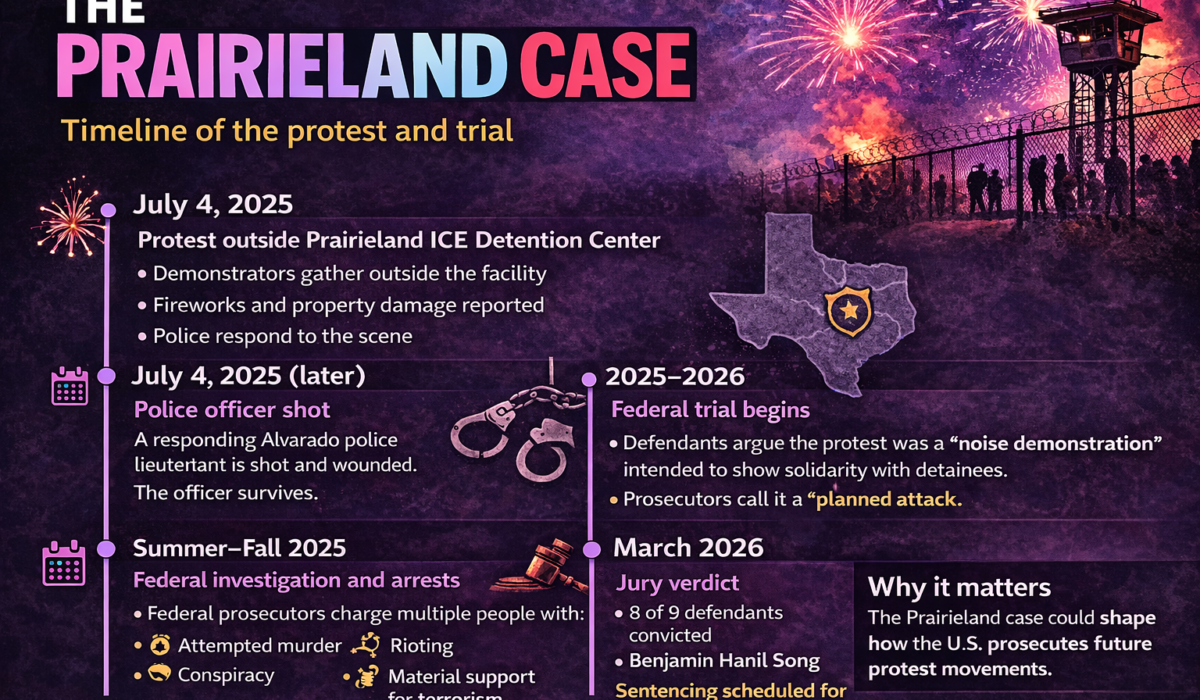
On July 4, 2025, a protest outside the Prairieland ICE Detention Center in Alvarado, Texas escalated into one of the most controversial federal protest prosecutions in recent years.
RELATED: Investigative Report: LGBTQ+ Immigrants Say ICE Detention Is “Another Trauma”
What began as a demonstration outside an immigration detention facility quickly became the center of a sweeping federal criminal investigation. Federal prosecutors ultimately charged a group of activists — now widely referred to as the Prairieland defendants — with a range of serious offenses including rioting, conspiracy, and terrorism-related charges.
The case has drawn national attention not only because of the charges involved, but because it raises a larger question:
When does protest become terrorism in the eyes of the federal government?
What Happened Outside the Prairieland ICE Facility
According to prosecutors, a group of individuals arrived at the Prairieland facility late on the night of July 4 wearing dark clothing and masks. Authorities say the group launched fireworks, vandalized property, and damaged vehicles and surveillance equipment outside the detention center.
When an Alvarado police lieutenant responded to reports of suspicious activity, prosecutors say one member of the group opened fire, shooting the officer in the neck.
The officer survived.
Federal authorities described the incident as a planned attack tied to anti-government extremism.
Defense attorneys, however, offered a very different interpretation of the events.
They argued the protest was intended as a “noise demonstration” — a tactic sometimes used by immigrant rights activists to let detainees inside detention facilities know they are not forgotten.
“The goal was to create noise that detainees could hear from inside the facility,” defense attorneys argued during the trial.
More Stories from QueerDispatch
The Charges Against the Prairieland Defendants
Federal investigators ultimately brought charges against more than a dozen people connected to the protest.
The charges included:
• Attempted murder of a federal officer
• Conspiracy
• Rioting
• Weapons offenses
• Providing material support to terrorism
Several defendants accepted plea deals earlier in the case. Others chose to fight the charges in federal court.
The government argued the group acted as a coordinated militant cell connected to anti-government ideology. Defense teams countered that the prosecution was attempting to frame protest activity as terrorism.
The Jury’s Verdict
In March 2026, after a 12-day trial in federal court in Fort Worth, a jury delivered its verdicts in the first major trial connected to the case.
Eight of the nine defendants on trial were convicted on multiple charges, including conspiracy, rioting, and providing material support to terrorism.
The most serious conviction was handed down to Benjamin Hanil Song, whom prosecutors said fired the shot that wounded the responding police officer.
Song was found guilty of attempted murder.
Another defendant, Daniel Sanchez-Estrada, was convicted of charges related to concealing documents tied to the case, despite not being present during the protest itself.
Sentencing for the convicted defendants is scheduled for June 18, 2026, and several face the possibility of lengthy federal prison sentences.
Why Civil Liberties Advocates Are Watching Closely
The Prairieland case has become a flashpoint in debates about protest, domestic extremism, and the reach of federal law enforcement.
RELATED: The Federal Government’s Trans Policy Shift Is Accelerating
Federal prosecutors framed the incident as an example of violent extremism tied to anti-government ideology.
Civil liberties advocates, however, say the case could represent a dangerous expansion of terrorism-related charges into protest activity.
“The outcome of this case could influence how federal prosecutors approach activist movements in the future,” one legal observer noted during the trial.
Critics of the prosecution argue that using material support for terrorism charges in connection with a protest could create a legal precedent that affects other movements — particularly those challenging federal agencies such as ICE.
A Case With National Implications
Even beyond the individuals convicted, the Prairieland case has become a symbol of a broader political conflict.
Across the United States, protests targeting immigration enforcement have intensified in recent years. At the same time, federal authorities have increasingly framed some forms of militant protest as domestic extremism.
The Prairieland verdicts may now shape how those tensions play out in courtrooms across the country.
With sentencing still ahead and additional related cases continuing through the courts, the legal battles surrounding the Prairieland protest are far from over.
But one thing is already clear:
The Prairieland case may become one of the most consequential protest prosecutions in modern U.S. immigration politics.
Follow this blog on Mastodon or the Fediverse to receive updates directly in your feed.

Kirstyn Piper Plummer is a Mom, Wife, Photographer, Reporter, IT Administrator and many other things.



Read More
- Trump Administration Investigates Massachusetts School Over Trans Student — But Key Facts Are Disputed
- The Education Department Collected Data on Trans Students. Then It Hid It.
- Federal Judge Limits UC Protections Against Intentional Misgendering
- Hungary Moves to Undo Anti-LGBTQ+ ‘Propaganda’ Rules as Turkey Detains 150 Protesters