
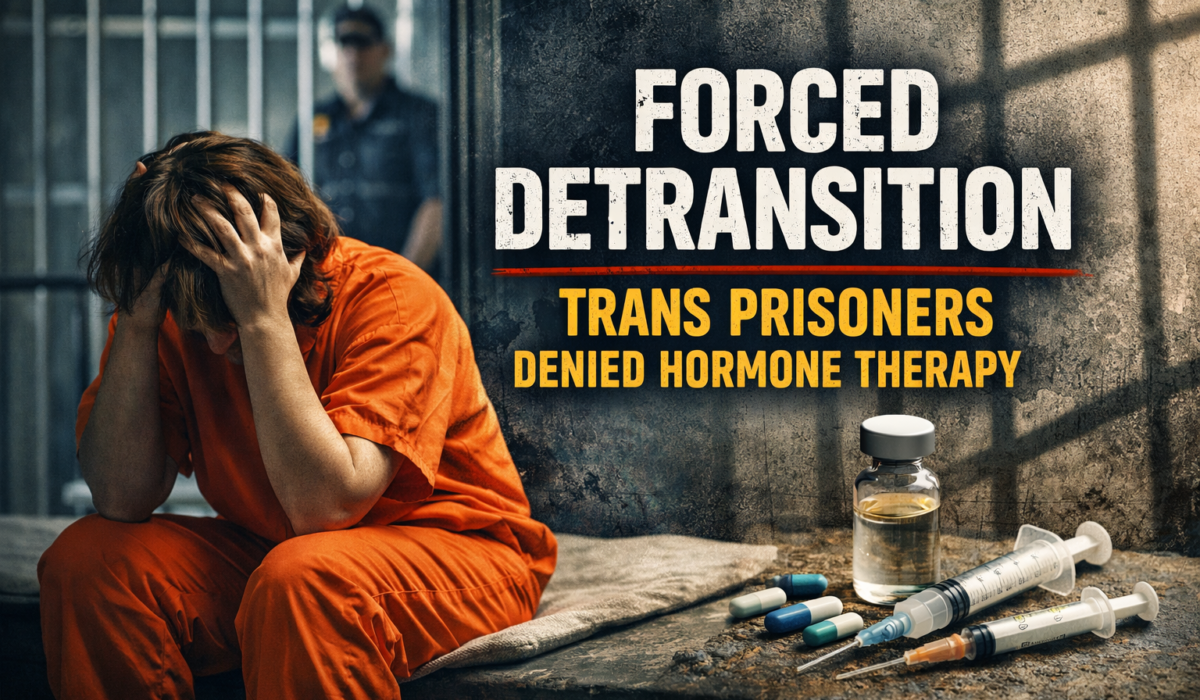
Across the United States, the federal government has begun stripping transgender prisoners of the medical care that many of them depend on to survive.
Advocates and legal observers warn that a quiet shift inside the U.S. Bureau of Prisons could force incarcerated transgender people to stop hormone therapy—even when doctors previously prescribed that treatment and even when patients have taken hormones for years.
For many prisoners, the policy change effectively amounts to forced detransition.
And for people already living in one of the most dangerous environments in the country for transgender individuals, the consequences could be devastating.
Medical Care Turned Into Punishment
Hormone therapy is not cosmetic care.
Major medical organizations — including the American Medical Association and the American Psychological Association — recognize it as medically necessary treatment for many transgender patients.
Cutting someone off from that care does not simply pause their transition.
It can trigger severe psychological distress, hormone withdrawal symptoms, and a return of gender dysphoria that many patients describe as unbearable.
For prisoners, the risks multiply.
Federal prisons already struggle to protect transgender inmates from violence. Removing the medical treatment that allows many trans people to live in alignment with their identity does not improve safety — it makes them more vulnerable.
The Reality of Trans Life Behind Bars
As a trans-feminine reporter writing this story, I cannot pretend to understand the experience of people serving long sentences in federal prison.
But I have seen enough to understand the terror of incarceration as a transgender person.
I spent five days in county jail.
More Stories from QueerDispatch
Those five days were enough.
At first, officials placed me in the infirmary under protective custody, isolating me in a medical cell. I remained separated from the general population and technically had access to a private shower.
Isolation protected me from other inmates.
It also meant I spent most of my time alone in a locked cell.
Later, the jail transferred me to male general population.
The difference felt immediate and terrifying.
I can state definitively that it is a horrifying situation to live in — a place where every sound makes your body tense.
Every footstep.
Every shout down the hallway.
Every door slam.
Not just because jail itself is a hostile environment.
But because you constantly fear that everyone else might be out to get you, and that if something happens, no one will care enough to stop it.
Five days felt like a lifetime.
Many transgender prisoners face that environment for years.
Removing Hormones Makes Prison More Dangerous
When authorities cut off hormone therapy, they do not merely change a medical record.
They change how prisoners exist in the system.
Hormones often influence physical appearance and body characteristics. Removing them can force transgender prisoners to experience physical changes that intensify dysphoria and draw attention from other inmates.
In an environment where difference already invites harassment, humiliation, or violence, that attention can quickly turn dangerous.
Advocates warn that forcing prisoners off hormones can also increase:
- severe depression
- suicidal ideation
- panic and trauma responses
- vulnerability to abuse
The federal government knows these risks.
Courts have recognized them repeatedly in lawsuits brought by incarcerated transgender people seeking access to treatment.
Yet the policy direction now emerging inside the prison system suggests that officials intend to move in the opposite direction.
A Pattern of Federal Anti-Trans Policy
The prison hormone policy does not exist in isolation.
Across federal agencies, new rules and directives increasingly attempt to redefine transgender people out of legal recognition.
Policies targeting healthcare access, immigration documentation, sports participation, and education have all appeared in rapid succession.
Each individual change may appear narrow.
Together they form a pattern.
One where the government increasingly treats transgender identity itself as a problem to regulate or eliminate.
For incarcerated people — who already possess the fewest legal protections and the least public visibility — the consequences arrive first.
The People Most at Risk
Transgender prisoners already face staggering levels of violence in custody.
Studies consistently show that transgender inmates experience sexual assault at dramatically higher rates than the general prison population.
Protective custody often isolates them for months or years.
General population placement exposes them to constant danger.
Removing access to gender-affirming medical care does not solve either problem.
Instead, it adds another layer of punishment onto people who are already living inside one of the harshest systems in the country.
A Question of Human Rights
The debate over transgender healthcare often plays out as a culture-war talking point.
But inside prisons, the stakes are not rhetorical.
They are immediate.
They are physical.
They are life-threatening.
When the government forces transgender prisoners to stop medically necessary hormone therapy, it does not simply change policy.
It places vulnerable people in deeper psychological distress while leaving them trapped inside environments where they cannot escape the consequences.
For many advocates, the question is simple:
If the government controls every aspect of someone’s life in prison — their housing, their safety, their medical care — does it also carry responsibility for protecting their dignity and survival?
Or will transgender prisoners become the next group whose suffering remains invisible behind prison walls?
What Comes Next
Legal challenges to restrictions on gender-affirming care in prisons have already begun to emerge in federal courts.
Civil rights attorneys argue that denying medically necessary treatment may violate constitutional protections against cruel and unusual punishment.
But court cases move slowly.
Policy changes can take effect immediately.
And for transgender people currently incarcerated in federal prisons, the consequences of those decisions are not theoretical.
They are happening now.
QueerDispatch will continue reporting on federal policies affecting transgender communities and the growing legal challenges surrounding them.
Follow this blog on Mastodon or the Fediverse to receive updates directly in your feed.

Kirstyn Piper Plummer is a Mom, Wife, Photographer, Reporter, IT Administrator and many other things.




[…] RELATED: [Forced Detransition: Federal Prisons Are Cutting Off Hormone Therapy] […]