⚖️ Another State’s Religious Classroom Law Falls in Court
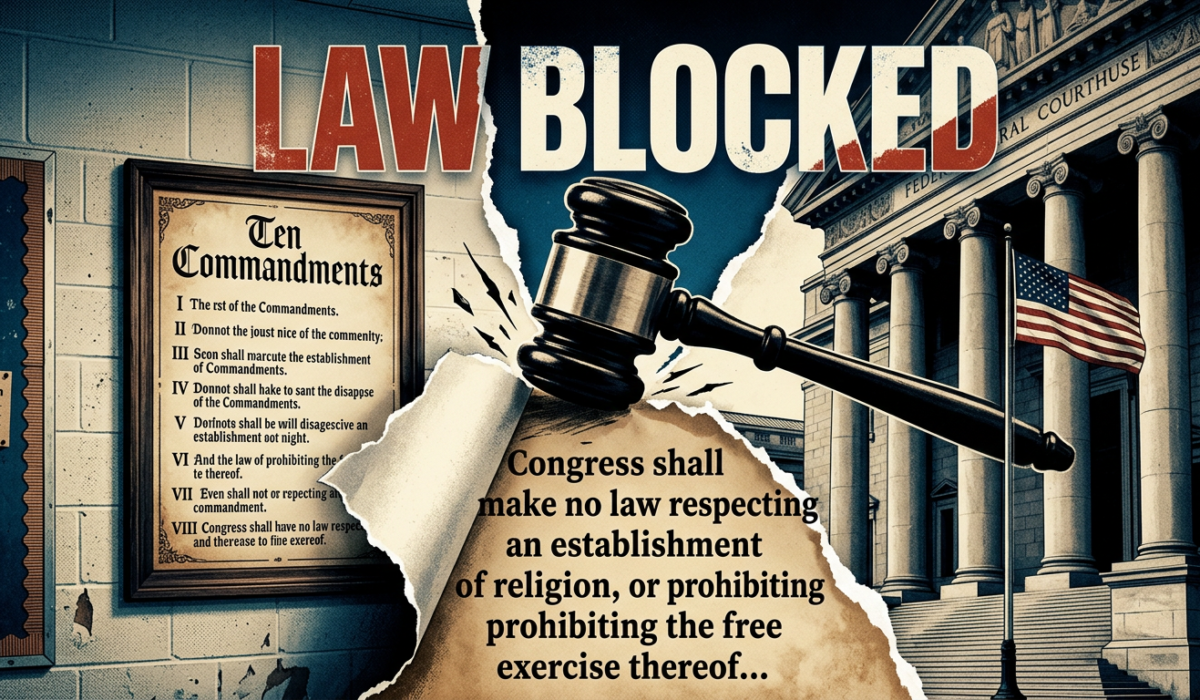
A federal court has blocked Arkansas’s law requiring the Ten Commandments to be displayed in public school classrooms, ruling that it violates the First Amendment.
The decision halts enforcement of the law and delivers another legal blow to a growing wave of legislation attempting to insert religious doctrine into public education.
🧾 What Arkansas Tried to Do
The Arkansas law would have required:
- The Ten Commandments to be prominently displayed in classrooms
- A state-approved version of the text
- Placement in a way that ensures students are regularly exposed to it
Supporters argued the displays were about “history” and “moral foundations.”
The court was not convinced.
🚫 The Court’s Ruling: Government Cannot Promote Religion
The federal court found that the law violates the Establishment Clause of the First Amendment.
In its reasoning, the court relied on long-standing precedent, including:
- Stone v. Graham
That case struck down a nearly identical Kentucky law, holding that posting the Ten Commandments in classrooms serves a primarily religious purpose.
The court made clear that Arkansas’ version does not escape that problem.
“Labeling a religious text as ‘historical’ does not make it secular—especially when the state mandates its display.”
🔥 A Pattern Emerging Across the Country
Arkansas is not alone. Similar efforts have been introduced or advanced in:
- Louisiana
- Texas
- Oklahoma
Courts are now sending a consistent message:
👉 Public schools cannot be turned into platforms for government-endorsed religion.
More Stories from QueerDispatch
⚔️ Testing the Limits of the Supreme Court
These laws are not accidental—they are part of a broader legal strategy.
Supporters have been trying to take advantage of newer rulings like:
- Kennedy v. Bremerton School District
That case shifted the legal framework toward “historical tradition,” leading some lawmakers to believe religious displays might now pass constitutional scrutiny.
So far, lower courts are pushing back.
🧭 Who Gets Included in Public Education?
Public schools are meant to serve everyone—but laws like this raise serious concerns:
- Students of different religions
- Students with no religious affiliation
- LGBTQ+ students already navigating hostile environments
When the state mandates a specific religious text, it sends a message about who belongs—and who doesn’t.
“Public education should not come with a religious requirement. That’s not neutrality—that’s endorsement.”
🚨 What Happens Next
This ruling is unlikely to be the final word.
Arkansas could appeal, potentially pushing the case toward higher courts. If similar cases continue stacking up across states, the issue could ultimately land before the U.S. Supreme Court.
And that’s where the real stakes lie.
📢 The Bottom Line
For now, the courts are holding the line:
The First Amendment still means the government cannot impose religion in public school classrooms.
But lawmakers across the country are continuing to test that boundary—case by case, state by state.
Follow this blog on Mastodon or the Fediverse to receive updates directly in your feed.

Kirstyn Piper Plummer is a Mom, Wife, Photographer, Reporter, IT Administrator and many other things.