A Discipline Bill With Bigger Implications
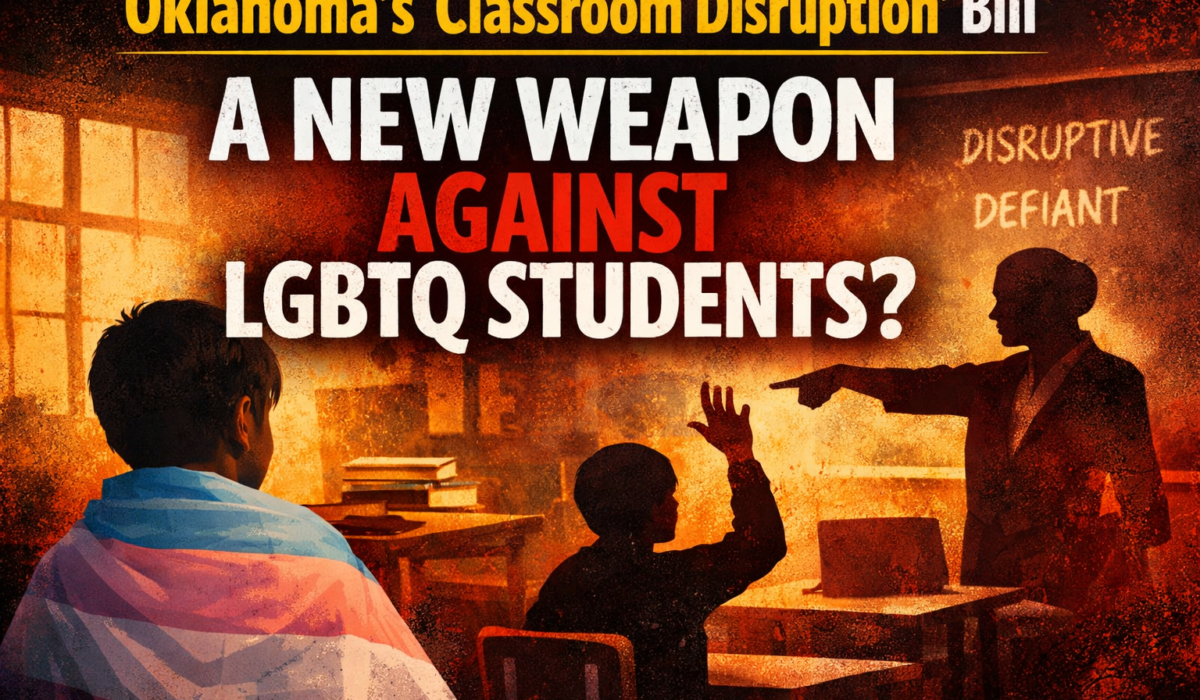
Oklahoma lawmakers are advancing a bill called the “Protected Learning Environment Act” (SB 1790)—framed as a way to restore order in classrooms.
On paper, it sounds routine: standardize discipline, reduce classroom disruptions, and give teachers more authority to remove students who interfere with instruction.
But look closer—and a more troubling picture emerges.
Because while the bill never explicitly mentions LGBTQ students, its broad, subjective definitions of “disruption” and “defiance” could make it a powerful tool to target them.
What the Bill Actually Does
SB 1790 would require Oklahoma schools to follow a statewide discipline system, categorizing student behavior into escalating tiers of severity.
Among the behaviors flagged as punishable:
- “Disrespect”
- “Noncompliance”
- “Dress code violations”
- “Classroom disruption”
- “Defiant behavior”
Teachers would be given expanded authority to remove students from class, while schools would be required to track and report behavioral incidents to the state.
Supporters say this ensures consistency.
Critics say it creates something else entirely: a standardized pipeline for punishment based on subjective judgment.
The Problem: Vague Language + Political Climate
None of those terms—disrespect, defiance, disruption—are clearly defined.
And that matters.
Because in practice, those labels often depend less on what a student does—and more on who that student is.
More Stories from QueerDispatch
In a state like Oklahoma, where lawmakers have repeatedly targeted transgender rights, that ambiguity becomes dangerous.
How This Could Be Used Against LGBTQ Students
Even without explicitly naming LGBTQ people, the bill creates multiple pathways for enforcement against them:
1. Pronouns = “Defiance”
A trans student correcting a teacher or refusing to respond to the wrong name could be labeled “noncompliant” or “defiant.”
2. Gender Expression = “Dress Code Violation”
Students wearing clothing aligned with their gender identity—but not with sex-based dress codes—could be punished under “dress code violations.”
3. Speaking Up = “Disruption”
Calling out anti-LGBTQ comments, defending oneself, or even participating in student activism could be framed as “classroom disruption.”
4. Existing Bias Gets Codified
If a school is already hostile, this bill doesn’t create new bias—it legitimizes it and gives it structure, documentation, and state backing.
“When you give schools vague tools like ‘defiance’ and ‘disruption,’ you’re not creating order—you’re creating a system that can punish identity.”
A Pattern We’ve Seen Before
This isn’t happening in a vacuum.
Across the country, lawmakers have shifted tactics. Instead of explicitly naming LGBTQ people, newer policies rely on neutral-sounding language with unequal impact.
We’ve already seen:
- Schools policing bathroom use
- Students disciplined for using correct pronouns
- LGBTQ expression labeled “inappropriate” or “disruptive”
SB 1790 fits squarely into that pattern.
The “Non-Discrimination” Clause—And Its Limits
The bill includes a line stating discipline must be applied “consistently and without discrimination.”
But history shows that language alone doesn’t stop biased enforcement.
If anything, it often provides cover.
Because once discipline is documented and categorized, it can be presented as neutral—even when it isn’t.
Why Reporting Requirements Matter
One of the most overlooked aspects of the bill is its requirement to track and report student behavior data statewide.
That raises serious concerns:
- Who is being labeled “disruptive”?
- Which students are being removed from classrooms most often?
- Could this data be used to justify further crackdowns?
👉No “Registry” — Yet: Are States Quietly Building Systems That Could Track Transgender Americans?
For LGBTQ students—already disproportionately targeted in school discipline—this could mean being flagged, tracked, and escalated through the system faster than their peers.
Why This Is Dangerous
Not every home is safe.
For some LGBTQ students, being outed can lead to:
- Emotional or psychological abuse
- Loss of housing or support
- Forced conversion efforts
- Increased risk of self-harm
According to multiple youth advocacy organizations, family rejection is one of the strongest predictors of homelessness and mental health crises among LGBTQ youth.
The bill requires schools to notify parents after repeated behavioral incidents.
On its surface, that sounds routine.
But when paired with vague categories like “defiance,” “disrespect,” or “noncompliance,” it creates a serious risk for LGBTQ students—especially those who are not out at home.
How This Becomes Forced Outing
For many LGBTQ students, school is one of the only places where they can safely express who they are.
If incidents are reported—and parents are notified—schools could effectively out students to their families without their consent.
“The laws don’t have to say ‘LGBTQ’ anymore. The impact does that on its own.”
The Bigger Picture
Oklahoma has been at the center of a growing wave of policies affecting LGBTQ students—from curriculum restrictions to gender identity bans.
SB 1790 doesn’t stand out because it’s loud.
It stands out because it’s quietly powerful.
👉Anti-Trans Groups Are Asking the FDA to Restrict Estrogen for Trans Women
It doesn’t need to say who it targets.
It just needs to give authority—and let existing bias do the rest.
What Happens Next
If passed, the bill would require schools to adopt the new discipline system by the 2027–2028 school year.
That gives districts time to prepare.
It also gives advocates time to respond.
Because once systems like this are in place, they’re much harder to challenge.
Final Takeaway
SB 1790 is being sold as a classroom management bill.
But in practice, it risks becoming something else:
A framework where identity, expression, and even self-defense can be redefined as “disruption.”
And in today’s political climate, that’s not a hypothetical concern.
It’s a warning sign.
Follow this blog on Mastodon or the Fediverse to receive updates directly in your feed.

Kirstyn Piper Plummer is a Mom, Wife, Photographer, Reporter, IT Administrator and many other things.



Read More
- The Education Department Collected Data on Trans Students. Then It Hid It.
- Appeals Court Blocks Trump Administration’s ‘Gender Ideology’ Conditions on Local Grants
- New Mexico Says It Will Use State Money to Keep Gender-Affirming Care Available to Trans Youth
- HHS Links Ordinary Transgender Affirmation to Political Violence