
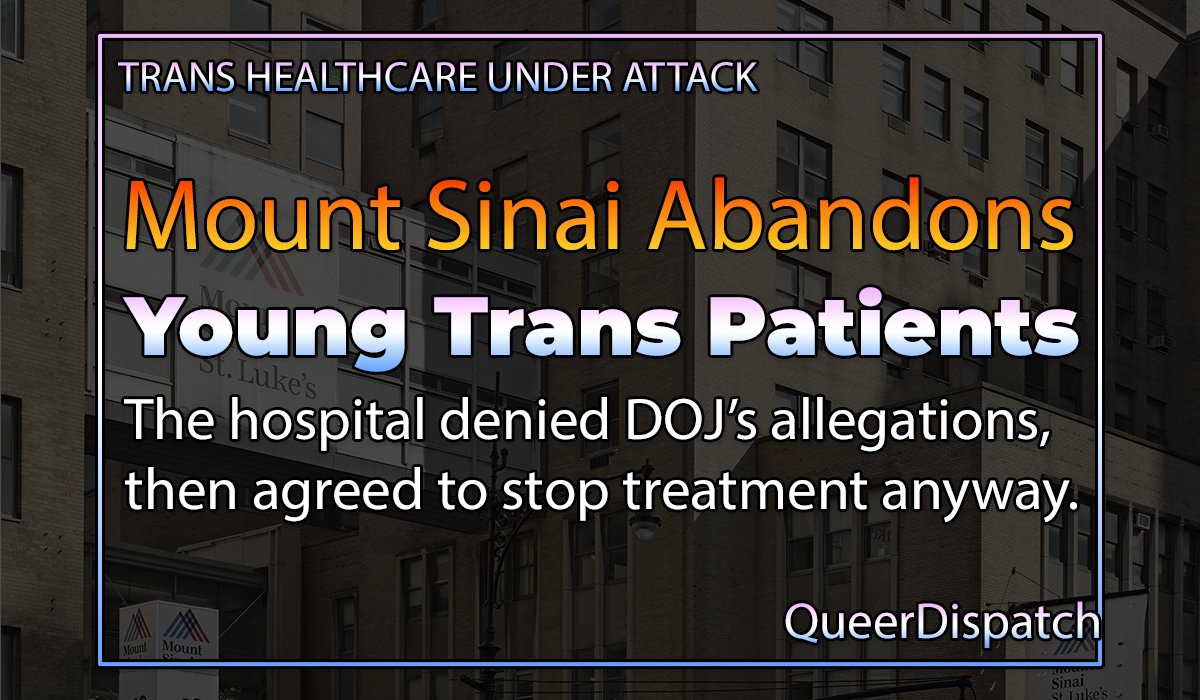
The New York hospital system denied the federal government’s allegations. No court found its care unlawful. Mount Sinai agreed to stop treating transgender minors anyway.
Mount Sinai Health System has agreed to stop providing gender-affirming medical care to minors, handing the Trump administration another victory in its campaign to make transgender healthcare functionally unavailable even in states where that care remains legal.
And there is an important distinction buried beneath the Justice Department’s celebration of the agreement:
Mount Sinai was not found guilty of providing illegal healthcare.
It did not admit that its treatment harmed patients.
It did not admit to committing fraud.
According to the Justice Department’s own announcement, the allegations against Mount Sinai remain just that — allegations. There has been “no determination of liability,” and Mount Sinai has denied the government’s accusations.
Mount Sinai agreed to stop treating transgender minors anyway.
For an institution that spent years presenting itself as a national leader in transgender medicine, that is difficult to describe as anything other than abandonment.
Mount Sinai chose a settlement
The agreement, announced Friday, September 4, requires Mount Sinai to stop providing puberty blockers, gender-affirming hormones and surgical procedures to patients under 18.
The health system will also pay an undisclosed monetary penalty and dedicate $2 million to free medical care for people the Justice Department says experienced harmful consequences from gender-affirming treatment they received as minors. DOJ described Mount Sinai’s commitment as funding for “detransition care.” The federal investigation was part of a nationwide Justice Department campaign targeting hospitals that provide gender-affirming healthcare to young people.
DOJ says investigators have been examining possible violations of the False Claims Act, Food, Drug and Cosmetic Act and other federal healthcare laws, including allegations involving medical billing codes.
More Stories from QueerDispatch
But its announcement of the Mount Sinai settlement does not establish that Mount Sinai committed any of those offenses.
Instead, the government expressly acknowledges that the claims are allegations, that there has been no finding of liability and that Mount Sinai denies them. That distinction matters.
This is not a story about a court discovering that Mount Sinai was secretly operating an illegal clinic.
It is a story about the federal government placing enormous legal and financial pressure on a healthcare institution until that institution decided transgender young people were a service it was willing to give up.
From “care for all ages” to no care for minors
The contrast with Mount Sinai’s own public messaging could hardly be sharper.
Its Center for Transgender Medicine and Surgery currently tells patients that it takes a team approach to transgender healthcare and provides primary care, hormone therapy, specialty care, surgery, behavioral health and other services.
Under a section titled “Pediatric/Adolescent Care,” Mount Sinai’s website still says:
“We provide care for transgender and gender patients of all ages.”
The webpage for its Keith Haring Youth Gender Center describes an interdisciplinary program built around transgender and gender-diverse young people. It says healthcare decisions are made collaboratively between the patient, the patient’s family and a multidisciplinary treatment team.
That was the promise.
Patient. Family. Medical team.
Not patient, family, medical team — and the United States Department of Justice.
Yet federal political pressure has now overridden the model Mount Sinai itself spent years presenting as appropriate medical practice.
New York has said this care is legal
Mount Sinai is not operating in a state that has banned gender-affirming healthcare for minors.
New York Attorney General Letitia James has repeatedly said that gender-affirming care remains legal and protected in New York, including for young people.
After the Supreme Court allowed Tennessee’s ban on gender-affirming care for minors to stand in 2025, James was explicit: “Gender-affirming care remains legal and protected in New York, including for young people.”
Her office had already warned hospitals that refusing services to transgender people because of gender identity or a diagnosis of gender dysphoria, while offering comparable services to cisgender patients, may constitute discrimination under New York law.
Mount Sinai has already faced that issue directly.
The New York City Commission on Human Rights previously filed a complaint against the health system alleging that it violated the city’s Human Rights Law after ceasing gender-affirming medical care for transgender and gender-nonconforming minors.
That means Mount Sinai now occupies an extraordinary position.
The federal government pressured it to stop providing care.
New York officials have warned that denying transgender patients care because they are transgender may violate state anti-discrimination protections.
And Mount Sinai chose capitulation to the federal government.
The pressure campaign is working
Mount Sinai is not the first hospital to make that calculation.
The Justice Department says it has obtained similar agreements from Texas Children’s Hospital, Cleveland Clinic Foundation and Connecticut Children’s Hospital.
That is precisely why this story is bigger than one New York hospital.
The Trump administration does not necessarily need Congress to pass a nationwide statutory ban on gender-affirming healthcare for transgender minors if it can make providing that care legally dangerous, financially risky and institutionally exhausting enough that hospitals simply stop doing it.
Investigations.
Subpoenas.
Threats to federal funding.
Fraud allegations.
Demands for patient records.
Settlements.
One institution at a time, access disappears.
And the strategy has continued even while courts have rejected portions of the administration’s campaign.
On August 26, the Second Circuit refused the administration’s latest attempt to obtain identifying and sensitive medical information belonging to transgender New Yorkers who received gender-affirming care as minors. The protected class includes patients who received care at New York City institutions including Mount Sinai.
Nine days later, Mount Sinai’s settlement was announced.
The government did not have to win every courtroom battle.
It only had to make the fight expensive enough that hospitals decided surrender was easier.
Mount Sinai had already lost the community’s trust
This did not begin Friday.
Mount Sinai and NYU Langone were already facing intense criticism from New York’s LGBTQ+ community over restrictions on gender-affirming care.
Ahead of New York City Pride this June, a coalition that included 19 current and former Pride grand marshals called for both institutions to be removed from the march because of their decisions to end or restrict care for transgender minors.
Former Pride grand marshal Elisa Crespo accused the hospitals of having “preemptively and proactively” ended care for trans youth.
Mount Sinai nevertheless remained scheduled to participate in Pride.
There is something particularly bitter about a healthcare institution marching alongside transgender people while deciding that some of those same people are too politically costly to treat.
Pride branding is easy.
Standing beside transgender patients when the federal government threatens you is apparently much harder.
This is what abandonment looks like
There may be lawyers, executives and accountants inside Mount Sinai who can explain exactly why the health system believed this settlement was preferable to continuing the fight.
They may have calculated the potential cost of federal investigations, litigation, funding threats and institutional exposure.
But transgender teenagers do not experience healthcare through a hospital’s risk-management spreadsheet.
They experience it through appointments.
Doctors.
Prescriptions.
Parents arranging transportation.
Months of waiting.
Relationships with clinicians they learned to trust.
And then, suddenly, a hospital tells them that the healthcare it once described as individualized, collaborative and medically appropriate is no longer available to them.
Not because New York banned it.
Not because Mount Sinai admitted the treatment was improper.
Not because a court ruled Mount Sinai’s program unlawful.
But because the federal government targeted it and the institution decided it would no longer fight to keep those patients.
The Justice Department calls that accountability.
QueerDispatch calls it what it looks like from the other side of the examination-room door:
Mount Sinai abandoned its young transgender patients.
Read More
- HHS Turns Anti-Trans Report Into Federal Referral List for DOJ Investigations
- New Jersey Is Back in the Fight, Challenging Trump Medicaid Ban on Trans-Youth Care
- DOJ Forces Third Children’s Hospital to End Trans Youth Care as Federal Pressure Campaign Expands
- Saddle Lake Cree Nation Turns Treaty Rights Into a Shield for Trans Lives
[…] to the Justice Department, similar agreements have already been reached with Mount Sinai Health System, Texas Children’s Hospital, Cleveland Clinic and Connecticut Children’s […]