I don’t remember every detail.
But I remember the feeling.
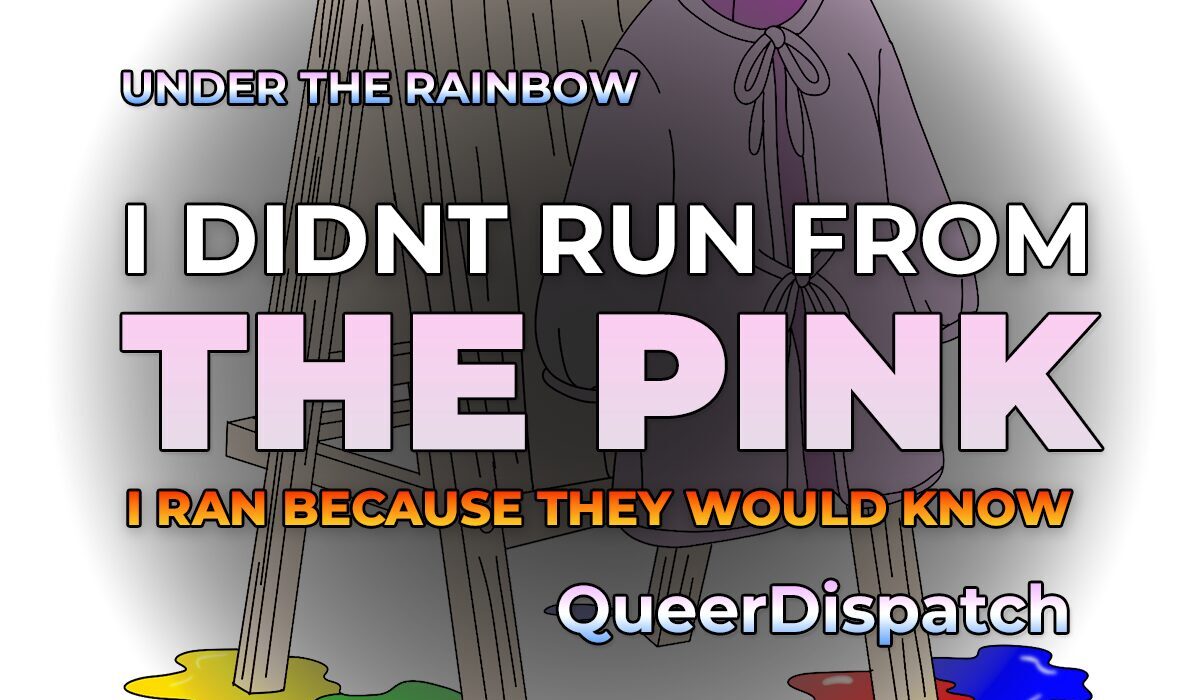
I was little, maybe two, maybe four. We were living in Natomas, California, just outside Sacramento. I was at a friend’s house for a playdate, the kind where adults say “go have fun” and kids are expected to just exist together.
There was finger painting.
And there was a smock.
Pink.
Someone, my friend’s mom I think, put it on me like it was nothing. Just part of the activity. Just something to keep paint off my clothes.
But I remember the panic.
Not loud. Not dramatic.
Just immediate.
Wrong.
I tore it off.
And I ran.
I don’t know if I actually made it all the way home. Memory doesn’t always give you the geography. But I remember the urgency, the need to get away from that moment, from being seen like that.
Because even at that age, I already knew something:
Pink wasn’t allowed for me.
Not because I believed it.
Because everyone else did.
A few years later, another house. Carmichael, California.
Before kindergarten.
The living room was full, cousins, aunts, noise, that familiar kind of family chaos. My cousin was in beauty school, and she was there to give my sister a perm.
I wasn’t the focus.
I rarely was.
I was sitting on someone’s lap, just watching.
And then—
She started wrapping my hair.
Perm rods. Pink and blue. End papers folded just right.
I remember sitting still.
Letting it happen.
Wanting it to happen.
No one stopped her at first. Maybe it was a joke. Maybe it was just something to pass the time before the “real” work started.
But then it got real.
“Make sure you leave some solution, I’ll need it here.”
And just like that, everything shifted.
Because now it wasn’t pretend anymore.
Now it meant something.
The argument wasn’t really about chemicals.
It was about boundaries.
About who gets to be what.
And again—
I ran.
This time I remember exactly where I went.
Outside.
To the front yard.
To the rock waterfall, the hollow space underneath where the pump was hidden.
That became my hiding place.
I crawled inside.
Curled up where no one could see me.
Because by then, I understood something even more clearly:
This wasn’t safe.
When they found me, the assumption was immediate.
They thought I ran because I didn’t want curly hair.
Because I didn’t want to look like a girl.
Because I was rejecting it.
But the truth is quieter than that.
And harder.
I ran because I wanted it too much.
I wanted the perm.
I wanted the pink.
I wanted the softness, the permission, the ease my sister seemed to exist in.
I wanted to play with her Barbies without it being a negotiation.
I wanted the Easter dresses her friends sometimes convinced her to put on me.
I wanted to exist without that constant, invisible correction pressing down on me:
That’s not for you.
That’s not who you are.
That’s not allowed.
Those moments weren’t about clothes.
Or hair.
Or colors.
They were about recognition.
And denial.
They were the first times I understood that who I was didn’t match what the world expected, and that the cost of being seen might be too high.
So I learned something early.
Before I had the language.
I learned how to hide.
Why This Matters
We talk a lot about “when people knew.”
As if there’s always a moment of clarity.
A declaration.
Something obvious.
But for a lot of us, it doesn’t look like that.
It looks like running.
It looks like silence.
It looks like being misunderstood in ways that stick with you for decades.
It starts earlier than people are comfortable admitting.
Not because someone told us who we were.
But because the world told us who we weren’t.
Over and over again.
I didn’t run because I was afraid of being a girl.
I ran because I already knew I wasn’t allowed to be one.
And that knowing?
That’s something no kid should have to carry.