Editor’s Note: This story discusses suicide. If you or someone you know is struggling, contact the 988 Suicide & Crisis Lifeline by calling or texting 988, the Trans Lifeline at (877) 565-8860, or The Trevor Project at (866) 488-7386.
There is a question lawmakers often refuse to answer when passing legislation that targets transgender youth.
When the bills are debated, when committees meet, when governors sign them into law, the conversation is almost always framed around “protecting children,” “fairness,” or “parental rights.”
But one question rarely receives the same attention:
What happens to the children who have to live inside these laws?
In Idaho, one family believes they know the answer.
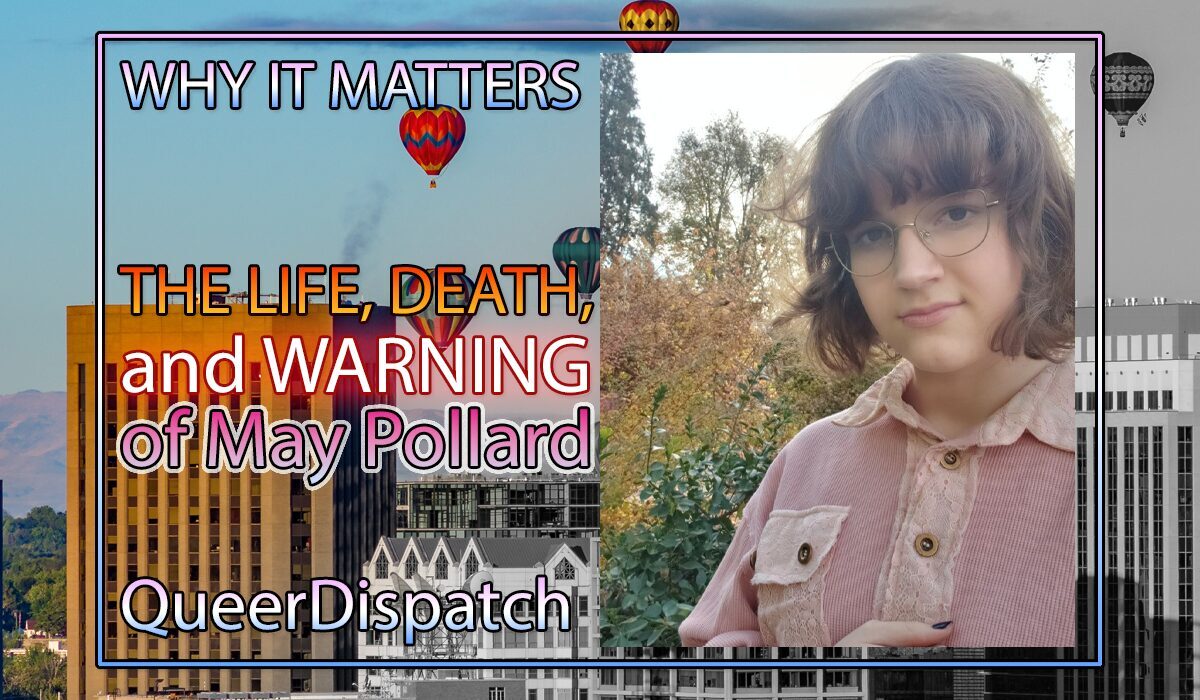
May Pollard was 16 years old.
She loved video games. She traveled with her father to PAX West in Seattle. She wrote poetry, adored sloths, excelled at mathematics, and carefully built what friends described as a “goth cottagecore” aesthetic while growing into her identity as a transgender girl.
In late January, she died by suicide in her Boise home.
When investigators asked her parents whether anyone had wanted to hurt their daughter, her mother, Elyse Thorpe, didn’t name a bully or a classmate.
“A lot of America,” she answered.
Her father, Joseph Pollard, was even more direct.
More Stories from QueerDispatch
“There is a huge amount of animosity, every single day, thrown at trans kids,” he told detectives. “The whole f—ing country. The whole f—ing administration, every single f—ing day.”
The Legislative Gauntlet
To understand the world May was living in, it is impossible to separate her life from the political climate surrounding it.
Over the past several years, Idaho has enacted numerous laws restricting the rights of transgender people. Since 2020, Governor Brad Little has signed multiple measures affecting transgender residents, including restrictions on participation in school sports, limitations on access to gender-affirming medical care for minors, classroom policies regarding gender identity and sexual orientation, and bathroom access in public schools.
One of those laws, Senate Bill 1100, required transgender students in K-12 public schools to use restrooms corresponding to their sex assigned at birth.
For May, the law wasn’t an abstract political debate.
It became part of her daily routine.
Unable to use the girls’ restroom, she instead used a single-user restroom, a solution that she believed effectively outed her to classmates every day.
In court documents filed under the pseudonym “Jane Doe” as part of a legal challenge to the law, she described the experience in painful detail.
“I fear that use of the single-user restroom has increased either the knowledge or suspicion of me being transgender against my wishes.”
She continued:
“I find being forced to use a separate restroom ostracizing, and I feel like I’m being treated like this other kind of thing.”
Rather than risk using the restroom at school, May reportedly stopped eating and drinking during the school day to avoid needing one.
The Cost of “Protection”
Supporters of these laws frequently argue they are protecting children.
May’s parents have asked a different question:
Who protects transgender children from the laws themselves?
When Idaho criminalized gender-affirming medical care for minors, Elyse Thorpe drove her daughter roughly 13 hours round-trip to Portland, Oregon, so May could continue receiving estrogen therapy.
Her parents supported her transition.
They attended support groups.
They did what they believed loving parents should do.
But, as Elyse later reflected:
“You worry about that hatred being internalized, and that’s what happened to my kid. It got inside.”
Research has consistently found associations between restrictive state laws targeting transgender youth and worsening mental health outcomes. A widely cited 2024 peer-reviewed study published in Nature Human Behaviour reported substantially higher rates of suicide attempts among transgender and nonbinary youth in states that enacted anti-transgender laws, though aspects of the study’s methodology have since become the subject of academic debate.
Whatever the statistical arguments, families like the Pollards are left confronting an intensely personal reality.
A Quiet Dismissal
May was one of the students challenging Idaho’s bathroom law in federal court.
Four months after her death, attorneys representing the Boise High School Sexuality and Gender Alliance voluntarily dismissed the lawsuit after May had died and another plaintiff graduated.
Idaho Attorney General Raúl Labrador celebrated the dismissal, stating that Idaho families could be confident the law would remain in effect.
When asked about May’s death, his office declined to comment on the personal circumstances of individuals involved in litigation.
Meanwhile, Idaho lawmakers continued advancing additional restrictions.
Earlier this year, Governor Little signed House Bill 752, expanding criminal penalties related to restroom access in certain public spaces.
The Warning
May Pollard never asked to become a political symbol.
She wanted to be a teenager.
She wanted to play games with friends.
She wanted to exchange messages about cats.
She wanted to live her life.
Instead, she became another young person whose existence was debated in legislative hearings, litigated in courtrooms, and scrutinized in political campaigns.
Her mother has repeatedly told lawmakers exactly what she feared would happen.
“The parents go and testify, and we say, ‘Children are going to die,’” Elyse Thorpe said.
“We tell the legislators that, and they dismiss it. I guess they think it’s hyperbole, or they think it’s hysteria, or they think it’s an acceptable outcome… So I don’t understand why there is an unwillingness to connect these laws to these outcomes.”
May Pollard’s death is first and foremost a human tragedy.
It is also a reminder that legislation is not experienced only in committee rooms or campaign speeches. It is experienced in classrooms, cafeterias, doctor’s offices, and family homes by the people whose lives those laws directly affect.
Regardless of where people stand politically, the question that remains is the same one lawmakers are so often unwilling to answer:
What happens to the children who have to live inside these laws?
Read More
- Appeals Court Blocks Trump Administration’s ‘Gender Ideology’ Conditions on Local Grants
- HHS Turns Anti-Trans Report Into Federal Referral List for DOJ Investigations
- New Mexico Says It Will Use State Money to Keep Gender-Affirming Care Available to Trans Youth
- New Jersey Bill Would Make Blocking Reproductive or Gender-Affirming Healthcare a Crime