As Alberta restricts gender-affirming care, Saddle Lake Cree Nation is asserting Treaty 6 rights and Indigenous sovereignty to build a refuge for transgender, Two-Spirit and gender-diverse people.
In Alberta, a First Nation is doing something governments too often refuse to do with their power: using it to protect transgender people rather than punish them.
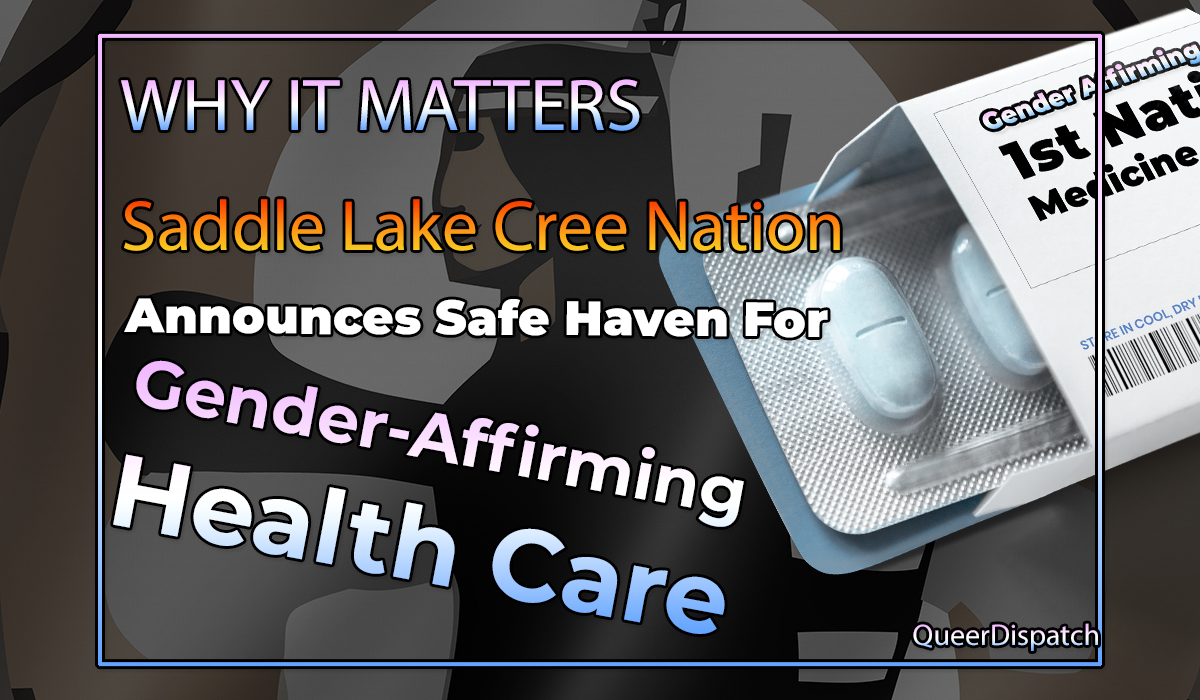
Saddle Lake Cree Nation announced Sept. 9 that it plans to establish a safe haven for gender-affirming health care on its reserve lands and territories, directly challenging restrictions imposed by Premier Danielle Smith’s United Conservative government.
And Saddle Lake is not asking Alberta for permission.
The Nation is invoking its inherent jurisdiction and the Medicine Chest clause of Treaty 6, arguing that access to health care is a treaty-protected right and that the province cannot simply legislate that responsibility away. Alberta Native News
That alone would make this significant.
But Saddle Lake is going further.
The planned refuge is intended to serve First Nations and non-First Nations people alike, with the Nation working toward its own health law, recruiting physicians and creating protections for clinicians who provide gender-affirming care on its lands. Prince Albert Herald
It is difficult to imagine a clearer demonstration of solidarity.
Alberta used its power to restrict care
Alberta’s restrictions prohibit health professionals from newly prescribing puberty blockers or hormone therapy for gender dysphoria or gender incongruence to children younger than 16, with limited exceptions. Gender-related surgeries are prohibited for minors.
Those restrictions went into effect after years of political targeting of transgender youth.
Then Alberta went further.
More Stories from QueerDispatch
In December 2025, the province passed Bill 9, the Protecting Alberta’s Children Statutes Amendment Act, invoking Canada’s notwithstanding clause to shield portions of its transgender health, education and sports laws from challenges under several Charter and provincial human-rights protections. Alberta.ca
In other words, when people affected by these laws turned toward constitutional protections, Alberta’s government deliberately placed some of those protections out of reach.
Saddle Lake Cree Nation has responded by reaching for something Alberta cannot so casually dismiss: Treaty.
A promise made 150 years ago
The timing was deliberate.
Saddle Lake made its announcement on Sept. 9, exactly 150 years after its ancestors entered Treaty 6 at Fort Pitt in 1876. GoFundMe
Treaty 6 contains what became known as the Medicine Chest clause:
“A medicine chest shall be kept at the house of each Indian Agent for the use and benefit of the Indians…”
The written language is brief, but First Nations have long maintained that the promise must be understood as an enduring commitment to health care rather than as a literal wooden box of nineteenth-century medicine. Canada’s own Indigenous Services department acknowledges that First Nations view treaties as living relationships whose provisions require modern interpretations. Indigenous Services Canada
That distinction matters.
Saddle Lake isn’t dusting off a historical curiosity to find a loophole.
It is asserting that a promise about health made between nations remains a promise about health in 2026.
“Today, we are those people”
Chief Dale Steinhauer connected the decision directly to Indigenous history and the consequences of governments taking decisions about children and families away from Indigenous communities.
“Our people know all too well the consequences of governments removing the rights of parents to be parents, and children to be children,” Steinhauer said in announcing the initiative. Canada News
The Nation’s response carries particular weight because Indigenous people know what supposedly benevolent government interference can become.
For generations, Canadian authorities separated Indigenous children from their families through residential schools and other colonial policies, often claiming that governments knew what was best for those children.
Steinhauer turned that history toward solidarity rather than isolation.
“When we were being stolen from our parents and experienced genocide in Indian Residential Schools, we wondered ‘Who are the people that will help us?’” Steinhauer said in a statement reported by Canadian media.
“Today, we are those people.” News Global Canada
That may be the most important part of this story.
Saddle Lake Cree Nation could have confined its argument to its own citizens.
It didn’t.
Instead, a community whose children were once subjected to government control is opening its jurisdiction to children and families now facing a different kind of government intrusion.
Protecting trans and Two-Spirit relatives
The Nation’s reasoning also rejects one of the recurring myths underlying modern anti-trans politics: that gender diversity is something newly invented or imported.
Saddle Lake specifically describes tastawiyiniwak, a Nehiyaw term used for LGBTQ2S+ people and roughly translated as “the in-between people,” as relatives who have always existed within Indigenous communities.
“They belong,” the Nation’s legal-defense fundraiser states.
Its proposed health framework specifically includes Two-Spirit, transgender and gender-diverse people and grounds their protection in Cree law, responsibility and concepts of community care. GoFundMe
Dr. James Makokis, a Nehiyô Two-Spirit family physician from Saddle Lake and a prominent provider of transgender health care, has been central to the effort.
Makokis described Alberta’s legislation as anti-trans and a violation of treaty rights while arguing that protecting gender-diverse people is consistent with both Indigenous law and the Nation’s responsibilities toward its relatives. News Global Canada
Alberta appears unwilling to pick this fight — at least for now
Perhaps the most striking response came from Premier Danielle Smith herself.
A day after Saddle Lake’s announcement, Smith told reporters:
“I don’t have any authority over the First Nation. I respect their sovereignty.”
That doesn’t resolve every legal question surrounding physicians, professional regulators or the scope of the Medicine Chest clause.
But it is a remarkable acknowledgement from the premier whose government’s restrictions created the confrontation in the first place. CityNews Calgary
And those unresolved questions are real.
Canadian courts have disagreed over how broadly the Medicine Chest promise should be interpreted, and the Supreme Court of Canada has never definitively ruled that Treaty 6 guarantees a comprehensive modern health-care system. Indigenous Services Canada acknowledged that unresolved legal history in a 2022 briefing to Parliament. Indigenous Services Canada
So Saddle Lake’s plan should not yet be described as an unquestioned legal exemption from every Alberta health regulation.
What the Nation has done is assert that jurisdiction, begin building the law necessary to exercise it and effectively invite Alberta or its regulators to challenge that assertion if they believe they can.
That distinction makes Saddle Lake’s decision no less powerful.
It makes it potentially historic.
This is what allyship looks like
There is something deeply moving about what Saddle Lake Cree Nation has chosen to do.
Not because Indigenous people owe transgender people rescue. They don’t.
Not because the struggles of Indigenous and transgender communities are interchangeable. They aren’t.
But because a Nation with its own long history of having governments interfere with families, suppress identities and decide which lives and traditions were acceptable has looked at another marginalized community being targeted and said: not here.
Not on our land.
Not to our relatives.
And, remarkably, not even to strangers who come seeking safety.
The provincial government invoked extraordinary constitutional power to preserve restrictions on transgender people.
Saddle Lake Cree Nation answered with an older promise, its own sovereignty and a radically different idea of what political power is for.
Not control.
Protection.
For transgender and Two-Spirit people watching governments compete to see who can restrict their lives most aggressively, that distinction matters.
Saddle Lake Cree Nation deserves recognition for making it.
And if the Nation succeeds in turning Treaty 6 into a functioning refuge for gender-affirming care, Canada may be watching something larger than resistance to one Alberta law.
It may be watching Indigenous sovereignty become a shield for people a colonial government decided it was willing to leave exposed.
Read More
- New Mexico Says It Will Use State Money to Keep Gender-Affirming Care Available to Trans Youth
- HHS Turns Anti-Trans Report Into Federal Referral List for DOJ Investigations
- Mount Sinai Abandons Its Young Trans Patients, Agrees to End Gender-Affirming Care
- Hungary Moves to Undo Anti-LGBTQ+ ‘Propaganda’ Rules as Turkey Detains 150 Protesters