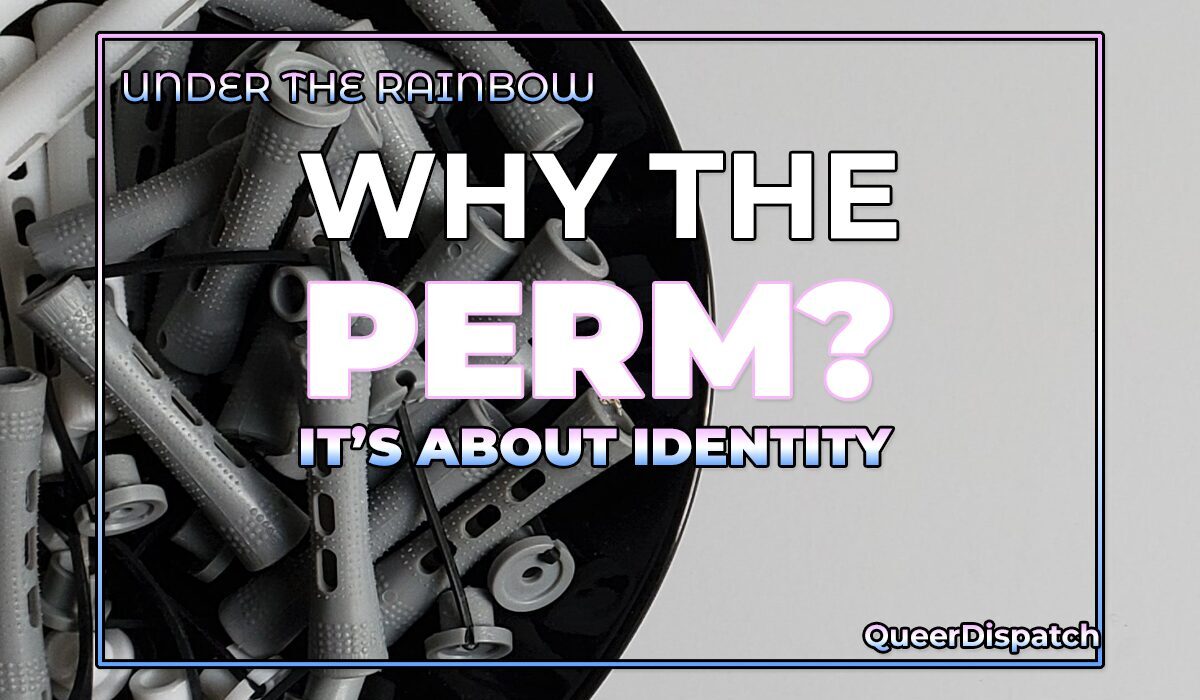
People joke about the perm.
Sometimes it’s playful curiosity.
Sometimes it’s confusion.
Sometimes it’s the assumption that there has to be something deeper or stranger behind it.
“Why a perm?”
The truth is both simpler and more complicated than people expect.
It’s not a fetish.
It’s not about trying to impress anyone.
And honestly, if my goal was performing femininity for other people, I’d probably wear makeup more than once every few months.
Instead, the perm is tied to memory.
When I was growing up, perms were everywhere around me. My mom had one. My sister had one. Her friends had them. Women in stores had them. Women on TV had them. Curly hair, teased bangs, volume, hairspray — all of it was part of the visual language of womanhood I absorbed as a child.
And when you grow up quietly studying womanhood from the outside, those details stay with you.
People assume gender identity is always about some grand revelation. But sometimes it’s built from tiny observations collected over years. The sounds of women talking in salons. The smell of perm solution. Curlers sitting on bathroom counters. Watching women fluff their hair in mirrors before going somewhere important.
Those things settle into you.
At some point in my childhood, I associated perms with being a woman. Not because curls themselves are feminine by nature, but because curls were part of the world of women I saw around me. The women I secretly wanted to be like.
And that distinction matters.
People hear stories like this and sometimes immediately jump to the idea of fetishization because they cannot separate gender expression from sexuality. But there is a huge difference between objectifying women and quietly imagining yourself growing up as one.
What I carried wasn’t fantasy.
More Stories from QueerDispatch
It was grief.
I had visions in my head for years of who I thought I would have been if I had been allowed to express myself openly.
I know exactly what that younger version of me looked like.
She absolutely would have worn floofy, poofy dresses as a little kid. She would have had pigtails and bangs. Sometimes braids. She probably would have gone through a tomboy phase too — jean shorts, tank tops, sneakers — but still with long curly hair bouncing around behind her.
That person existed in my imagination long before I ever had the language to describe being transgender.
And in a strange way, the perm became part of reconnecting with her.
As an adult, there’s another practical side too: my hair is thinning. The curls give it bounce. Volume. Movement. But emotionally, it goes beyond that. The perm helps align the person I see in the mirror with the person I carried internally for most of my life.
Not perfectly. Not magically. But enough.
Enough to feel right.
Enough to feel familiar.
Enough to quiet a very old ache I didn’t fully understand when I was younger.
That’s the thing people often miss about transition and gender expression. It isn’t always about becoming someone new. Sometimes it’s about recovering pieces of yourself that existed privately for decades.
The perm matters because it connects memory, identity, comfort, and imagination together in a way that’s hard to explain to someone who never had to mentally rehearse an entire alternate version of their life.
And maybe that sounds silly to some people.
But if you spent your childhood watching the women around you and quietly thinking, that’s who I’m supposed to become, you’d understand why something as simple as curly hair can mean everything.
Yes. Not curly hair for me, but long hair. Straight, I like my hair straight.
Even when I must be male, I like long hair, bright clothes, and sparkly things. It’s just who I am. I have been blackballed for it, more than once. But I have to be true to who I am, because otherwise I’m living a lie. Why shouldn’t I be who I want to be rather than who everyone else wants me to be?
Wear your curls sis… wear them with pride that you know who you are.