The Sixth Circuit ruled that Hamtramck could close its flagpoles to private expression—even after city officials openly connected the restriction to religious objections to LGBTQ+ visibility.
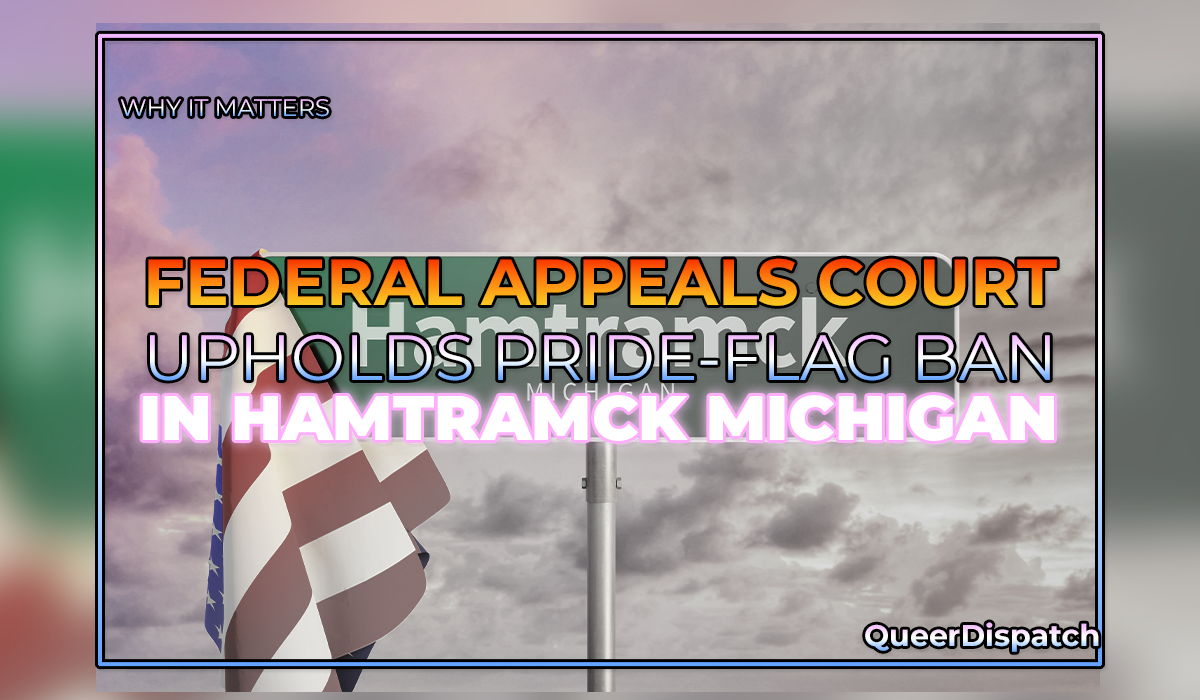
A federal appeals court has upheld Hamtramck, Michigan’s ban on flying Pride flags from city-owned flagpoles, ruling that the city converted those flagpoles into a platform for government speech rather than a forum open to residents.
In an August 21 decision, a three-judge panel of the U.S. Court of Appeals for the Sixth Circuit affirmed a lower court’s dismissal of the constitutional challenge brought by former Hamtramck Human Relations Commission members Russ Gordon and Cathy Stackpoole.
The court did not decide that governments may single out Pride flags wherever they appear. Nor does Hamtramck’s policy prohibit residents or businesses from displaying Pride flags on private property.
Instead, the ruling rests on a narrower—but potentially consequential—principle: A government may take a flagpole previously used for community expression, close it to private speakers and reserve it for a tightly controlled list of messages selected by the government.
Once Hamtramck did that, the court concluded, the First Amendment’s Free Speech Clause no longer required the city to include LGBTQ+ expression.
A policy written to appear neutral
Hamtramck adopted Resolution 2023-82 in June 2023, prohibiting flags representing religious, ethnic, racial, political or “sexual orientation” groups from being flown on city property.
The resolution permits only the American flag, Michigan’s state flag, Hamtramck’s municipal flag, the POW/MIA flag and national flags representing what the city calls Hamtramck’s “international character.”
On paper, that list excludes more than Pride flags. In practice, however, the policy emerged from a sustained fight over LGBTQ+ visibility.
The Pride flag had flown from Hamtramck flagpoles in 2021 and 2022. After a new mayor and councilmembers took office, officials began pushing for its removal.
During the public hearing on the 2023 resolution, Councilmember Mohammed Hassan Choudhury said the city wanted to respect residents’ religious rights.
“You guys are welcome to the community,” Choudhury told LGBTQ+ residents, according to the appellate opinion. “But we have to respect the religious.”
More Stories from QueerDispatch
The council unanimously adopted the restriction.
Weeks later, Gordon and Stackpoole raised a Pride flag on one of the city-owned flagpoles along Joseph Campau Avenue because they believed the policy violated the Constitution. Mayor Amer Ghalib and a councilmember directed police to remove it.
The council subsequently removed Gordon and Stackpoole from the Human Relations Commission and stripped the commission of its authority over city flagpoles.
They sued Hamtramck, the City Council and Ghalib, alleging violations of the First Amendment’s Free Speech and Establishment Clauses as well as the Fourteenth Amendment’s Equal Protection Clause.
The government-speech loophole
The central legal question was whether the flags represented private citizens speaking through a public forum or the city government delivering its own message.
That distinction matters enormously.
When a government creates a forum for private expression, it generally cannot exclude a speaker merely because officials dislike the speaker’s viewpoint. But when the government itself is speaking, it has broad authority to select the messages it wants to communicate.
Writing for the court, Judge Karen Nelson Moore concluded that Hamtramck established a “tightly controlled, closed-list system of flag selection.”
The city removed the Human Relations Commission officials who had exercised broader discretion, took direct control of the flagpoles and limited the permitted displays. Those actions, the court held, transformed the flagpoles into a forum for government speech.
“Nothing in Resolution 2023-82 allows the public to participate in flag selection,” Moore wrote.
The ruling draws heavily from the U.S. Supreme Court’s 2022 decision in Shurtleff v. Boston. In that case, the Supreme Court found that Boston violated the First Amendment when it rejected a Christian organization’s flag after routinely allowing private groups to use a City Hall flagpole.
But Shurtleff also gave municipalities a roadmap: Governments can avoid such constitutional challenges by formally closing their flagpoles to private expression and making clear that any flags flown represent the government’s own speech.
Hamtramck followed that roadmap.
The Sixth Circuit assumed, without deciding, that the city’s flagpoles may once have served as a public forum. It nevertheless held that a government is not required to keep such a forum open forever.
Religious objections were not enough to invalidate the ban
Gordon and Stackpoole also argued that the policy violated the Establishment Clause because city officials enacted it to accommodate religious opposition to LGBTQ+ people.
The court rejected that argument, finding that the resolution’s text did not endorse a particular religion and that its stated purposes—government neutrality and control over official displays—were constitutionally permissible.
The panel declined to treat statements about respecting religious objections as proof that the city’s stated neutral purpose was a sham.
The court also noted that Ghalib, who testified that same-sex relationships are considered sinful in religion, did not cast a vote on the resolution.
Judge Amul Thapar agreed that the policy was constitutional but wrote separately to argue that courts should not examine whether government action has a secular purpose at all. He maintained that Establishment Clause disputes should instead be evaluated through historical practices and whether the government coerced religious participation.
That concurrence could carry consequences beyond this particular flag dispute. If courts abandon scrutiny of governmental purpose, officials may have even more room to cloak religiously motivated policies in facially neutral language.
Equality by erasure is not neutrality
Hamtramck officials characterized the policy as neutral because it excludes multiple categories of private flags.
But removing every identity flag does not erase the circumstances under which a restriction was created—or who was expected to disappear from public view.
The Pride flag was not accidentally caught inside a broad housekeeping policy. It was the subject of the controversy that produced the policy. Officials discussed religious objections to it, imposed the restriction and then removed two commissioners after they raised it anyway.
The Sixth Circuit’s ruling does not declare that history irrelevant. It effectively says that history was not enough to overcome Hamtramck’s decision to convert its flagpoles into government speech.
That creates a usable strategy for other municipalities: Officials may be able to eliminate a Pride flag without expressly banning LGBTQ+ expression alone, provided they close the forum broadly enough and describe the remaining displays as the government’s own message.
The constitutional distinction may be legally coherent. For LGBTQ+ residents looking toward their own city government, however, the message is considerably simpler.
Hamtramck decided which communities it was willing to recognize from public flagpoles. Pride was removed from the list.
And the federal courts have now said the Constitution does not require the city to put it back.
Primary source: Read the Sixth Circuit’s decision in Gordon v. City of Hamtramck
Read More
- Australia’s High Court Ends Tickle v. Giggle Appeal, Leaving Trans Discrimination Win Intact.
- Federal Judge Again Strikes Down Texas Drag Ban
- Appeals Court Blocks Trump Administration’s ‘Gender Ideology’ Conditions on Local Grants
- New Mexico Says It Will Use State Money to Keep Gender-Affirming Care Available to Trans Youth