
An Australian court has upheld a landmark ruling against one of the country’s most prominent anti-trans activists after judges found that false claims about transgender women playing soccer crossed the line from political opinion into unlawful vilification.
The decision marks another significant legal defeat for Kirralie Smith, CEO of the anti-LGBTQ+ advocacy group Binary Australia, whose campaign against transgender women playing in women’s soccer targeted players Riley Dennis and Stephanie Blanch with repeated social media posts and public commentary. On July 24, the New South Wales Supreme Court dismissed Smith’s appeal, leaving in place a judgment ordering Smith and Binary Australia to pay AU$95,000 in damages, remove offending posts, and publish a court-approved apology across their social media platforms for three months.
At the heart of the case was a claim Smith repeatedly promoted online in 2023.
Smith alleged that Dennis, a transgender woman playing semi-professional soccer in New South Wales, had hospitalized two cisgender women during a match.
But when the case reached court, those allegations unraveled.
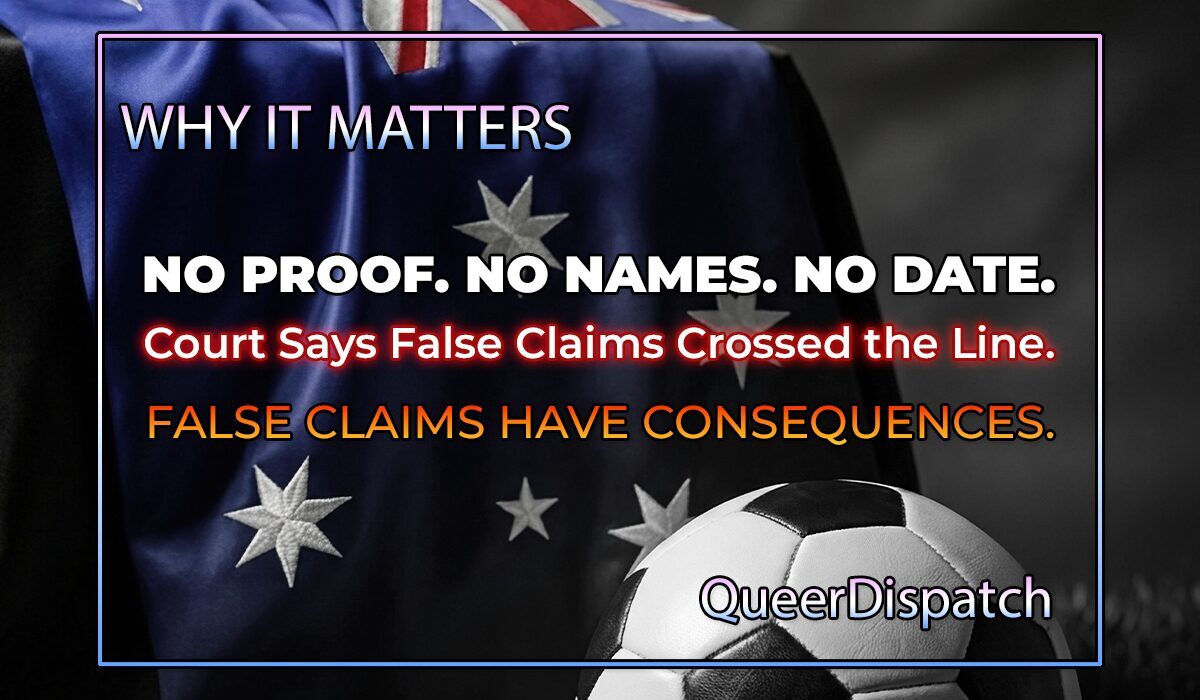
Under questioning, Smith acknowledged she could not identify the players who were supposedly injured, could not say when the incident occurred, could not identify which game it happened in, and had no evidence tying Dennis to the alleged injuries.
“I didn’t injure anyone. I didn’t hospitalize anyone,” Dennis testified.
The court found those unsupported allegations formed part of a broader pattern of conduct directed at Dennis because she is transgender.
A Campaign That Went Beyond Social Media
According to evidence presented during the proceedings, Smith’s campaign extended well beyond online commentary.
She posted photographs of Dennis while describing her as “a man appropriating womanhood.”
She also wrote on X that she wanted men to help deal with what she described as “the bloke playing on the women’s team.”
Smith later traveled with a group of men dressed to impersonate transgender women, filming them playing soccer in videos intended to mock transgender athletes.
More Stories from QueerDispatch
Dennis testified that the online attention soon spilled into real life.
Men began appearing at her actual matches to film her from the sidelines.
“All of a sudden I just felt like there were a thousand eyes on me,” Dennis told the court.
She later lost her place in the league and believes the sustained public campaign contributed directly to that outcome.
Judge: The Conduct Was “Objectively Threatening”
The court was unconvinced that Smith’s actions amounted to ordinary political debate.
A judge described aspects of Smith’s conduct as “objectively threatening” and “disturbing,” concluding that the campaign encouraged serious contempt and ridicule toward Dennis and fellow player Stephanie Blanch because they are transgender.
The ruling became the first successful finding of unlawful transgender vilification under New South Wales law, establishing that anti-trans campaigns targeting identifiable individuals can violate anti-discrimination protections when they incite hatred, contempt, or severe ridicule.
Appeal Fails
Smith argued that her comments were protected political speech and challenged the constitutionality of New South Wales’ anti-vilification laws.
The Supreme Court rejected those arguments, leaving the original findings largely intact.
Smith and Binary Australia must now:
- Pay AU$95,000 in damages to Riley Dennis and Stephanie Blanch.
- Remove the unlawful posts.
- Publish a court-approved statement acknowledging the court’s findings.
- Keep that apology prominently displayed on their social media accounts and website for three months.
Why It Matters
Disagreement over policies involving transgender participation in sports remains a contentious public issue in many countries.
This case, however, was not decided on whether people may debate sports policy.
Instead, the courts focused on something much narrower: whether an identifiable transgender woman was falsely accused of seriously injuring other players without evidence, then subjected to a sustained public campaign that encouraged contempt and ridicule because she is transgender.
The ruling reinforces an important distinction that often gets lost online.
Public debate is protected.
Knowingly—or recklessly—spreading unsupported allegations about identifiable people is something else entirely.
As Dennis put it after years of litigation:
“It didn’t pass.”
For many transgender people, that statement carries weight beyond a single court case. It is a reminder that while online misinformation can spread quickly, evidence still matters—and courts can distinguish between protected opinion and harmful falsehoods aimed at real people.
Read More
- She Was Allowed to Row. The Lawsuit Says Her Coaches Made Sure She Wouldn’t Belong.
- New Jersey Bill Would Make Blocking Reproductive or Gender-Affirming Healthcare a Crime
- Australia’s High Court Ends Tickle v. Giggle Appeal, Leaving Trans Discrimination Win Intact.
- Appeals Court Blocks Trump Administration’s ‘Gender Ideology’ Conditions on Local Grants
[…] Court Rejects Anti-Trans Activist’s Appeal After False Claims About Trans Soccer Player […]