A federally commissioned report treats using chosen names and pronouns as part of an ideology associated with authoritarianism—a tactic that echoes historical patterns flagged by genocide-prevention experts.
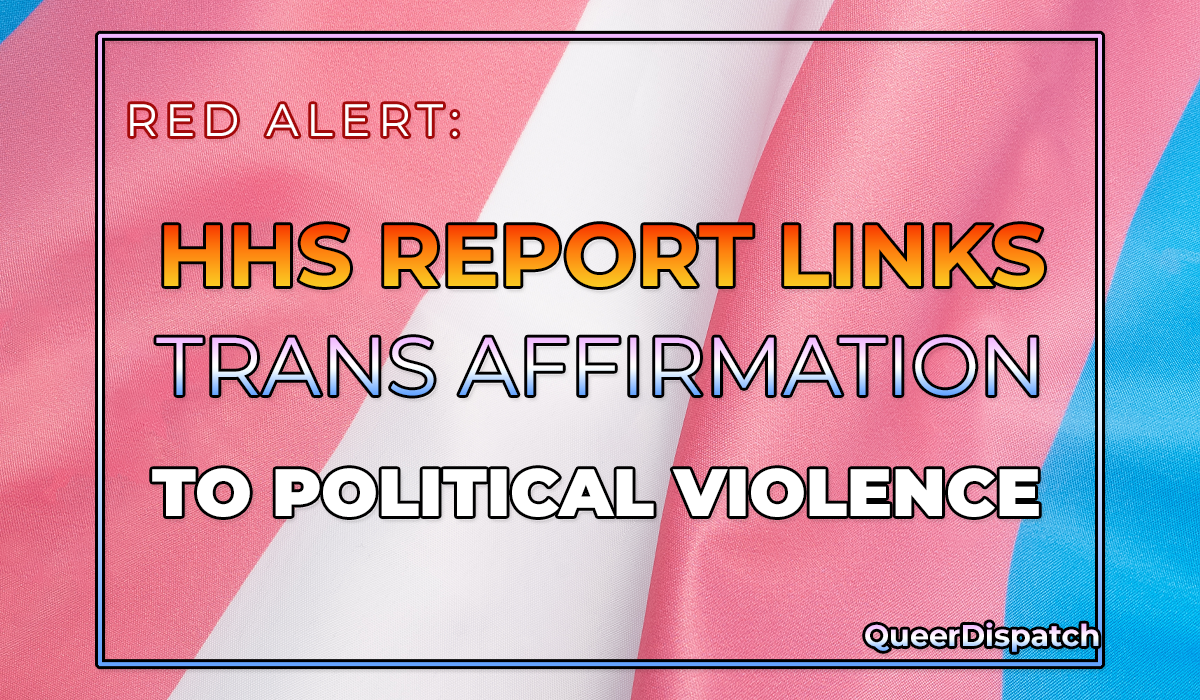
The U.S. Department of Health and Human Services has published a report drawing a statistical connection between ordinary transgender-affirming beliefs and approval of political violence.
The report acknowledges that its research cannot establish causation, measure violent conduct or show that anyone intended to commit violence. Nevertheless, HHS promoted the findings as evidence that people who embrace what the agency calls “radical gender ideology” are more likely to hold “left-wing authoritarian” views and consider political violence justified.
Released on August 26, 2026, the HHS-commissioned report is titled Where the Clinic Meets the Movement: Does Gender Ideology Arm Left-Wing Authoritarian Psychology?
Its implications extend beyond a single survey. By placing routine expressions of support for transgender people inside a narrative about political extremism, a federal health agency is helping redefine affirmation itself as a potential warning sign.
HHS classified routine affirmation as “gender ideology”
Researchers surveyed 1,208 U.S. adults using a newly created “Clinical Gender Affirmation Scale,” or CGAS.
The five-item scale was based on positions derived from guidance issued by the American Psychological Association, American Psychiatric Association, World Professional Association for Transgender Health and American Academy of Pediatrics.
According to HHS, the scale measured views involving transgender identity, gender expression, chosen names, pronouns, parental support and the psychological consequences of rejection.
Respondents did not have to endorse violence, medical intervention or a radical political program to receive a high score. Agreement with familiar affirming practices—such as using a transgender person’s chosen name and pronouns or supporting a child exploring their gender—was enough.
HHS referred to these positions as “sex-rejecting clinical beliefs” and “radical gender ideology.”
The survey found that higher affirmation scores correlated with both a separate measure of “left-wing authoritarianism” and greater approval of six politically violent scenarios. The correlations between affirmation scores and approval of violence reportedly ranged from 0.23 to 0.35. The authoritarianism measure produced stronger correlations, ranging from 0.47 to 0.54.
“This study raises important questions about what happens when ideology is given the authority of medicine,” Assistant Secretary for Health Brian Christine said in the HHS announcement.
More Stories from QueerDispatch
But the research does not demonstrate that transgender affirmation causes authoritarianism or violence.
The survey measured opinions—not violent behavior
The six scenarios asked respondents to assess the justification of the killings of President Donald Trump, conservative activist Charlie Kirk and UnitedHealthcare executive Brian Thompson. Other questions involved burning Immigration and Customs Enforcement buildings, damaging wealthy people’s property and violence against police.
Every example involved a target or act the researchers associated with the political left.
The survey included no corresponding set of questions about approval of violence associated with the right, such as attacks on abortion providers, LGBTQ venues, election workers or government institutions. Its design therefore cannot establish whether the reported pattern is distinct to transgender affirmation or partly reflects respondents’ reactions to partisan scenarios selected by the researchers.
The sample was also politically uneven. Approximately 55% of participants were Democratic or Democratic-leaning, compared with 27.2% who were Republican or Republican-leaning. Only about 1.1% identified as transgender or gender-nonconforming.
The report consequently provides little information about transgender people’s own attitudes or actions.
Most importantly, participants were asked whether described or hypothetical violence could be justified. Researchers did not examine violent conduct, preparations for violence or an intention to commit violence.
HHS acknowledges these limitations. Its announcement states that the study does not establish whether affirming beliefs contribute to authoritarian attitudes, whether the relationship runs in the opposite direction or whether an outside factor influences both.
The findings establish an association among answers given in an online survey. They do not establish that transgender people or those who support them pose a violent threat.
Critics call the report a political project
The study was commissioned by HHS and produced by researchers affiliated with Rutgers University, the conservative Manhattan Institute and the Network Contagion Research Institute.
The published document does not identify an academic journal, a digital object identifier or a completed independent peer-review process.
The Human Rights Campaign described the report as a politically motivated attempt to portray transgender Americans as dangerous.
“For nearly two years now, the Trump administration and officials like Robert F. Kennedy Jr. have used our own government as a cudgel against LGBTQ+ people, and increasingly, the transgender community specifically,” HRC President Kelley Robinson said in the organization’s response.
Robinson also unequivocally rejected political violence.
“But neither should demonizing entire groups of people for political gain,” she continued. “Trans people are not an ideology, they are human beings and our fellow Americans who deserve the same dignity as anyone else.”
HHS has not announced a regulation or enforcement action based on the study. But official reports can shape how future policies are explained and justified, even when the underlying research does not support the broader political message attached to it.
From human beings to a dangerous “ideology”
The report fits a pattern genocide-prevention specialists identify as an early warning sign of group persecution: Members of a minority are gradually discussed less as people and more as manifestations of a corrupting ideology.
Under this framework, the minority’s existence becomes a threat to children, families, medicine or the nation. Professionals who recognize the group’s identity are accused of enabling harm. Friends, relatives and advocates can then be portrayed as collaborators or extremists.
The HHS report advances each part of that framework. Transgender identity becomes “gender ideology.” Established practices of affirmation become “sex-rejecting beliefs.” Medical and psychological organizations become sources of ideological authority. People who agree with their guidance are statistically connected to authoritarianism and political violence.
That does not make the United States identical to Nazi Germany. It does, however, invite comparison with mechanisms visible during the early consolidation of Nazi power.
The historical warning from 1930s Germany
Before the Nazis took power, Berlin was home to Magnus Hirschfeld’s Institute for Sexual Science, a pioneering center for research, advocacy and some of the world’s earliest gender-affirming treatment.
Hirschfeld, a Jewish physician and sexologist, advocated for gay and transgender people and challenged laws criminalizing sexual minorities.
On May 6, 1933, Nazi-aligned students and storm troopers attacked the institute. They removed thousands of books and patient records, many of which were publicly burned four days later. The institute was forced to close as the regime dismantled queer organizations, gathering places and emerging networks of medical support.
The U.S. Holocaust Memorial Museum documents the destruction of Hirschfeld’s institute and the knowledge it had accumulated about sexuality and gender.
Transgender people were not persecuted through a single, consistently applied legal category, and their experiences should not be collapsed into those of every other population targeted by the Nazi regime. They nevertheless lost institutions, medical support and the limited public recognition they had achieved. Some were arrested, imprisoned or forced to conceal their identities.
The relevant historical parallel is a political sequence:
First, a minority’s identity is declared illegitimate. The medicine and scholarship supporting that minority are then discredited. Public affirmation is characterized as corruption or indoctrination. Supporters are treated as dangerous. State authority is eventually used to drive the group out of public life.
History does not have to repeat perfectly for that sequence to deserve attention.
The Lemkin Institute’s transgender genocide warning
The Lemkin Institute for Genocide Prevention and Human Security issued its third Red Flag Alert concerning anti-transgender policies in the United States on March 11, 2026.
The institute said the country was “squarely within the early to middle stages of a genocidal process against trans people,” citing escalating legislation and government efforts to erase transgender identity from healthcare, law and public institutions.
That warning should be described precisely.
The institute was not claiming that mass extermination was already occurring. It was describing genocide as a developing process that can involve destroying a group’s capacity to exist openly and reproduce itself socially—not only the immediate mass killing most commonly associated with the word.
The Lemkin Institute pointed to efforts to remove transgender people from public life, prevent legal recognition of their identities, restrict healthcare, impose hostile institutional conditions and portray their existence as a threat to the nation.
Its assessment remains the position of that organization, not a legal judgment from a court or an official determination by an international tribunal. But red-flag warnings are intended to identify dangerous patterns before persecution reaches its most catastrophic stage.
Waiting for mass violence before examining those patterns would defeat the purpose of genocide prevention.
RED ALERT: Why the HHS report matters
The HHS study does not show that transgender people are violent. It does not show that transgender affirmation causes political extremism. It does not even measure whether respondents planned to harm anyone.
What it does is place routine support for transgender people inside an official federal narrative about authoritarianism and violence.
That framing could have consequences independent of the survey’s scientific merits. Once an identity is presented as an ideology and affirmation is associated with radicalization, discrimination can be reframed as public safety. Healthcare restrictions can be presented as protection. Surveillance or institutional exclusion can be justified as a response to extremism.
This is the connection to the 1930s and to the Lemkin Institute’s warning: not a claim that every historical condition is the same, but recognition of a familiar political mechanism.
The danger begins when the government stops speaking about a minority as people entitled to dignity and starts speaking about their existence—and anyone who affirms it—as a threat.
Read More
- New Mexico Says It Will Use State Money to Keep Gender-Affirming Care Available to Trans Youth
- Under The Rainbow: Sometimes the Bravest Thing You Can Do Is Have an Ordinary Day
- HHS Turns Anti-Trans Report Into Federal Referral List for DOJ Investigations
- Mount Sinai Abandons Its Young Trans Patients, Agrees to End Gender-Affirming Care