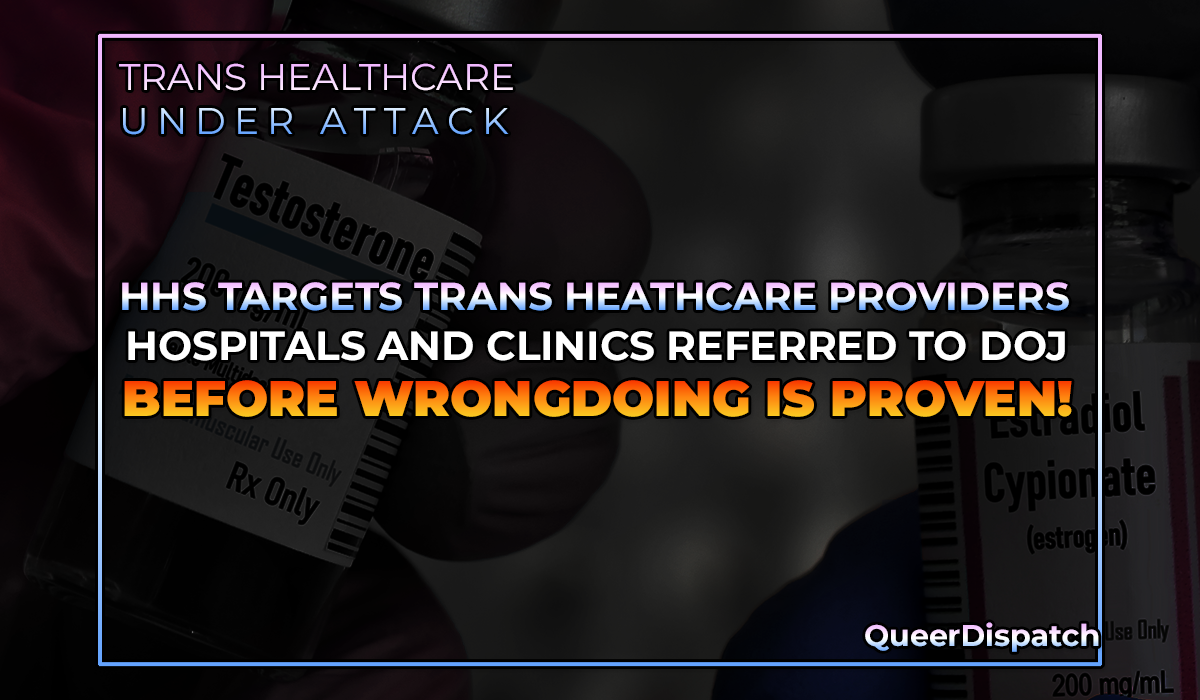
The department’s report admits its insurance data represents “directional signals rather than findings.” The Trump administration nevertheless sent the listed hospitals, clinics and pharmacies to federal investigators.
The Trump administration has escalated its campaign against transgender healthcare providers, referring hospitals, clinics, pharmacies and other medical organizations to the Department of Justice and the Department of Health and Human Services Office of Inspector General for possible investigation.
The referrals were announced Thursday alongside a provocatively titled HHS report, Wolves in White Coats: How Doctors and Hospitals Pushed and Profited from the Fraud of “Gender Medicine.”
That title tells readers what HHS wants them to believe before any investigation has occurred.
According to the department, Vice President JD Vance and HHS Secretary Robert F. Kennedy Jr. referred organizations identified in the report for possible violations of federal law. The allegations primarily concern insurance claims for puberty blockers that carried general endocrine-disorder or precocious-puberty diagnosis codes rather than a diagnosis explicitly related to gender dysphoria.
But HHS has not announced criminal charges, proven intentional fraud or established that every provider on its sprawling list treated transgender patients.
The report’s own methodological disclosure says its results should be treated as “directional signals rather than findings” and must be verified against patients’ underlying medical records.
That critical distinction did not stop the administration from turning those signals into a federal referral list.
A report written like a prosecution
This is not the language of an agency impartially announcing an audit.
The report repeatedly calls gender-affirming healthcare “sex-rejecting procedures.” It describes providers as “wolves in white lab coats,” accuses the medical establishment of creating “captive patients” and claims transgender healthcare may represent only “the tip of the iceberg” of fraud.
Those are political conclusions, not neutral medical terminology.
The list of contributors also raises serious questions about how the report was constructed. It includes representatives affiliated with the Center for Christian Virtue, Independent Women’s Forum, Independent Women’s Law Center and the Ethics and Public Policy Center — organizations closely associated with conservative political advocacy and opposition to gender-affirming care.
More Stories from QueerDispatch
HHS did not present the report as a peer-reviewed study produced by an independent panel of pediatric endocrinologists, coding specialists and transgender-health experts. It described it as a “commissioned report.”
The administration then used that commissioned document to recommend federal scrutiny of scores of healthcare organizations.
What the insurance data actually shows
HHS says its analysis found approximately $50 million in insurance claims between 2015 and 2025 for puberty blockers provided to patients ages 9 through 17 when the claim included a general endocrine-disorder code but neither a gender-related diagnosis nor a precocious-puberty diagnosis.
A second group included nearly $11 million in claims for patients ages 13 through 17 carrying a precocious-puberty code.
Those billing patterns may warrant review. Suspected healthcare fraud should be investigated based on evidence, regardless of the treatment involved.
But a suspicious-looking code is not itself proof of fraud.
The report acknowledges several significant limitations:
- Patient ages were estimated from birth years, with July 1 assigned as an artificial birthdate.
- The dataset contained billing claims, not complete patient records.
- Being named in the appendix indicates only that an organization had at least one claim meeting the report’s criteria.
- The list does not indicate how many claims were associated with each provider.
- Multiple versions of the same organization’s name appear separately.
- The data was not sufficient to determine why a provider selected a particular code.
- Verification against the underlying records is still required.
In other words, the report identifies claims the authors consider worthy of further examination. It does not establish that a provider deliberately submitted a false diagnosis, that a patient lacked the condition listed or that the treatment was related to gender dysphoria at all.
Nevertheless, the administration’s public presentation uses words such as “fraudulent” and “predatory” as though those questions have already been settled.
New Jersey providers appear in the data
The report’s appendices include organizations throughout the country, ranging from major children’s hospitals to pharmacies, infusion services and small medical practices.
New Jersey-associated names include Overlook Hospital and Tenafly Pediatrics in the report’s cohort involving puberty-blocker claims carrying a precocious-puberty diagnosis.
Their presence on the list does not establish that either organization committed fraud or even that the associated treatment involved a transgender patient. Under the report’s own methodology, it means only that at least one qualifying insurance claim was associated with the organization.
That caveat matters, especially when the federal government releases a list under a title accusing doctors and hospitals of fraud.
A referral is not a conviction. A billing signal is not a medical record. And a patient receiving a medication also used in transgender healthcare is not automatically a transgender patient.
The administration has tried this before
The referrals do not exist in isolation.
In July 2025, the Justice Department announced more than 20 subpoenas targeting doctors and clinics that provided gender-affirming healthcare to minors. Attorney General Pam Bondi said the investigations could involve healthcare fraud and false statements.
A federal judge later quashed the subpoena issued to Boston Children’s Hospital.
U.S. District Judge Myong Joun found that the demand was excessively broad and said the government appeared to be attempting to intimidate the hospital, interfere with Massachusetts’ protections for gender-affirming care and discourage patients from seeking treatment.
“The Government may be correct that it need not provide probable cause for its investigations,” Joun wrote, “but it cannot use its subpoena power to go on a fishing expedition.”
Boston Children’s appears again in the new HHS report.
The repetition makes the administration’s intentions difficult to miss. When one route for obtaining patient and provider records meets resistance in court, the government develops another allegation, another report and another pathway into the same healthcare systems.
First the funding ban, then the referrals
The report arrived just days after the administration finalized a rule ending federal Medicaid and Children’s Health Insurance Program funding for puberty blockers, hormone therapy and certain surgeries provided as gender-affirming care to young people.
That rule is scheduled to take effect October 13, 2026, although legal challenges are expected.
Taken together, the actions form a coordinated pressure campaign:
First, restrict how care can be funded.
Then characterize the treatment as inherently suspect.
Next, search insurance data for billing patterns that can be portrayed as criminal.
Finally, refer the providers to federal investigators while publicly labeling them as profiteers.
Even if an investigation produces no charges, the threat alone can accomplish part of the administration’s goal. Hospitals may close programs, doctors may leave the field, pharmacies may refuse prescriptions and families may lose access to care that remains legal in their states.
The investigation becomes the punishment.
Billing fraud should be investigated — not manufactured
There is nothing wrong with auditing medical claims. Providers who knowingly submit false information to obtain payment can and should face appropriate consequences.
But legitimate oversight begins with evidence and follows it toward a conclusion.
This report begins with the conclusion that gender-affirming healthcare is fraudulent, ideological and predatory. It then interprets ambiguous billing data through that political premise.
The government is not merely asking whether a particular claim was coded correctly. It is using the possibility of miscoding to cast suspicion over an entire field of healthcare and the transgender young people who depend upon it.
If HHS truly intends to “follow the evidence,” as Secretary Kennedy claims, it must acknowledge where its evidence ends.
A diagnostic code without a medical chart is not proof of deception. A provider’s name in a claims database is not proof of wrongdoing. And a commissioned ideological report is not a verdict.
The administration may have created its referral list.
It has not proven its case.
Read More
- Mount Sinai Abandons Its Young Trans Patients, Agrees to End Gender-Affirming Care
- New Mexico Says It Will Use State Money to Keep Gender-Affirming Care Available to Trans Youth
- New Jersey Is Back in the Fight, Challenging Trump Medicaid Ban on Trans-Youth Care
- Saddle Lake Cree Nation Turns Treaty Rights Into a Shield for Trans Lives