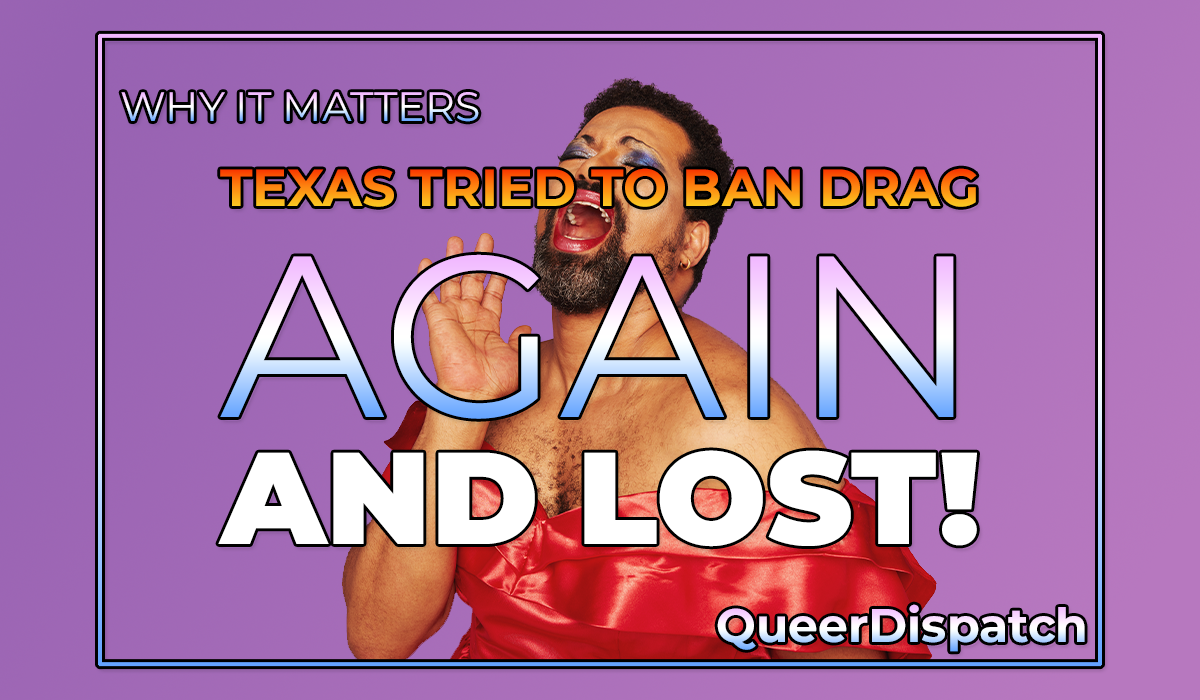
U.S. District Judge David Hittner has again declared Texas Senate Bill 12 unconstitutional, ruling that the law restricting so-called “sexually oriented performances” violates the First Amendment and permanently blocking Attorney General Ken Paxton from enforcing it.
Texas got its second chance.
It still lost.
A federal judge has again declared Texas Senate Bill 12, the state’s sweeping restriction on so-called “sexually oriented performances,” unconstitutional, handing drag performers and LGBTQIA+ advocates another major First Amendment victory after an appeals court temporarily revived the law earlier this year.
U.S. District Judge David Hittner issued an amended permanent injunction Tuesday, August 25, declaring SB 12 an unconstitutional restriction on speech and permanently barring Texas Attorney General Ken Paxton from enforcing it.
And this time, Texas cannot simply argue that Hittner failed to consider what the appeals court told him to consider.
That is exactly what he just did.
Texas Already Lost the Drag-Ban Fight Once
Texas lawmakers passed SB 12 in 2023 amid a nationwide Republican campaign targeting drag performances, drag story hours and LGBTQIA+ events under the banner of “protecting children.”
Earlier versions of the legislation were much less subtle about their target, specifically describing performers portraying a gender different from their own through clothing, makeup and performance.
The explicit references to drag were eventually stripped from the final bill.
The purpose was considerably harder to erase.
Gov. Greg Abbott publicly promoted the legislation as a restriction on drag performances, and the lawsuit challenging it was brought by drag performers, entertainment companies and LGBTQIA+ organizations who argued that the law threatened constitutionally protected artistic expression.
More Stories from QueerDispatch
The final version of SB 12 prohibits businesses from hosting a “sexually oriented performance” in the presence of someone younger than 18 and restricts such performances on public property where they could reasonably be seen by children.
Businesses could face civil penalties of up to $10,000 per violation, while performers could face a Class A misdemeanor.
But the law’s definition of what qualifies as prohibited performance became its constitutional problem.
Again.
The Fifth Circuit Gave Texas Another Chance
Hittner first struck down SB 12 in September 2023, concluding after a two-day trial that the legislation violated the First Amendment.
Texas appealed.
The case eventually reached the conservative U.S. Court of Appeals for the Fifth Circuit, which vacated Hittner’s original injunction and sent the case back to him.
Importantly, however, the appeals court did not rule that SB 12 was constitutional.
Instead, it said Hittner needed to conduct a more specific analysis under newer Supreme Court precedent governing facial First Amendment challenges. The Fifth Circuit also narrowed which plaintiffs had standing and which government officials could properly remain defendants.
The injunction was vacated, and SB 12 finally became enforceable in March 2026 while the litigation continued.
So Hittner went back and did what the Fifth Circuit instructed him to do.
Texas still lost.
In his new ruling, Hittner concluded that the law is facially overbroad and unconstitutionally vague, finding that its unconstitutional applications substantially outweigh any legitimate ones.
He declared SB 12 unconstitutional under the First Amendment and permanently enjoined Paxton from enforcing it.
Paxton’s request for additional discovery or another trial was also denied.
Why Texas’s Drag Ban Is Unconstitutional
One of the biggest problems with laws like SB 12 is what happens when lawmakers attempt to translate a political culture-war slogan into an actual criminal statute.
“Ban drag around children” may fit neatly onto a campaign mailer.
Writing a constitutional law that distinguishes a drag performer from practically every other performer in America is much harder.
Hittner noted that SB 12’s sweeping definitions could potentially reach performances far outside anything normally described as a drag show.
Think provocative cosplay.
Cheerleaders.
Swimmers.
Theater.
Concerts.
Elvis impersonators.
Or Dolly Parton.
The government would essentially have to decide which performances are sufficiently “erotic,” which clothing is sufficiently revealing and what expression supposedly appeals to a “prurient interest in sex.”
Those decisions do not suddenly become constitutionally acceptable simply because Texas invokes children.
Especially when constitutionally protected speech is involved.
The First Amendment does not disappear when a performer puts on a wig.
Drag Is Not Automatically Obscene
There is another principle buried underneath years of anti-drag legislation that deserves to be said plainly:
Drag is not pornography.
Drag is not automatically sexual.
And a performer wearing clothing traditionally associated with another gender does not transform an otherwise lawful performance into obscenity.
That distinction has repeatedly been blurred by politicians who describe virtually any LGBTQIA+ expression visible to children as inherently sexual while applying completely different standards to comparable heterosexual or gender-conforming performances.
The result is exactly the kind of viewpoint discrimination the First Amendment is designed to prevent.
A state can regulate actual obscenity.
It can enforce generally applicable laws governing nudity and sexual conduct.
It can impose legitimate age restrictions on genuinely adult entertainment.
What it cannot do is redefine protected expression until the government gains the power to punish the performers it dislikes.
That is the line Texas keeps running into.
The Judge’s Answer: “Just Don’t Go”
Hittner ended part of his analysis with an answer to people who find drag performances offensive that is considerably simpler than creating an unconstitutional criminal law:
That may be the most important line in the entire case.
Freedom of expression does not require everyone to approve of drag.
Parents do not have to bring their children to a drag performance.
Churches do not have to host one.
People who find drag offensive are entirely free to criticize it, protest it or avoid it.
What they do not have is a constitutional right to make the government silence it for everyone else.
That distinction increasingly seems to be disappearing from the political conversation around LGBTQIA+ rights.
Freedom does not mean being guaranteed that nobody will ever do something you dislike.
Sometimes freedom means somebody else gets to exist loudly, colorfully and publicly while you choose to walk past.
Texas Is Expected to Appeal Again
Paxton has already indicated that Texas intends to appeal the new ruling.
That means SB 12 could return to the Fifth Circuit, and the litigation may continue well beyond this decision.
But the posture of the case matters.
This is no longer simply a district judge issuing the same opinion Texas challenged three years ago.
The Fifth Circuit told Hittner what legal standards he needed to apply.
He applied them.
And SB 12 still came out unconstitutional.
For drag performers in Texas, that is an important victory.
For the broader LGBTQIA+ community, it is also another reminder that the First Amendment remains one of the strongest barriers against government attempts to turn discomfort with queer expression into censorship.
Texas tried to write drag out of public life.
Then it rewrote the law.
Then it appealed.
Then it got another chance.
And the Constitution is still standing in the way.
Read More
- Federal Judge Limits UC Protections Against Intentional Misgendering
- Appeals Court Upholds Hamtramck’s Pride-Flag Ban, Calling City Flagpoles Government Speech
- Hungary Moves to Undo Anti-LGBTQ+ ‘Propaganda’ Rules as Turkey Detains 150 Protesters
- The Education Department Collected Data on Trans Students. Then It Hid It.