
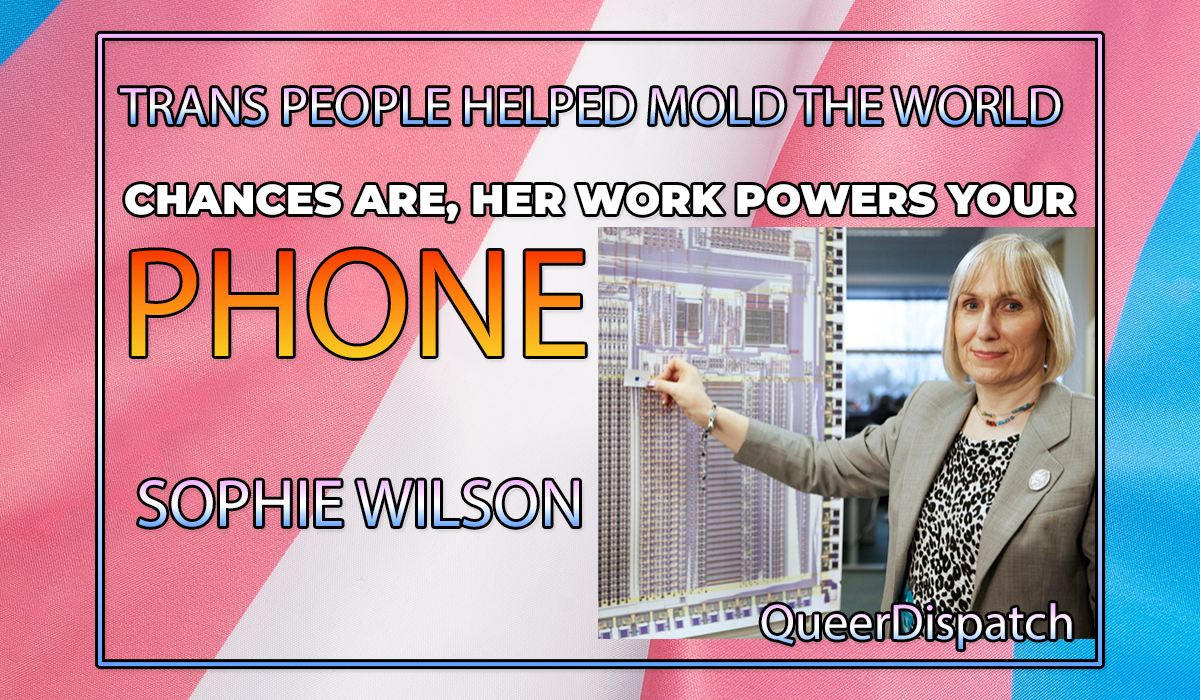
TRANS PEOPLE HELPED MOLD THE WORLD
Sophie Wilson Helped Build the Computer in Your Pocket
Before Sophie Wilson transitioned, she had already helped create the BBC Micro, written BBC BASIC and co-designed the architecture that would become ARM. Her life poses a simple problem for the claim that trans women transition to gain an advantage: What advantage, exactly?
If you are reading this on a smartphone, there is a very good chance you are holding a descendant of Sophie Wilson’s work in your hand.
The same is true if you use a modern tablet, an Apple Silicon Mac or any of countless other electronic devices built around ARM-based processors.
Wilson is one of the most important computer engineers of the modern era.
She is also a transgender woman.
And the chronology of those two facts matters.
Long before Wilson transitioned in 1994, she had helped build a computer that introduced a generation of British students to programming. She had written a highly regarded implementation of the BASIC programming language. And she had co-designed the processor architecture that would eventually become one of the foundations of modern mobile computing.
Those accomplishments weren’t something she gained access to by becoming a woman.
They were already hers.
Before the smartphone, there was the BBC Micro
Wilson’s career in computing began extraordinarily early.
Born in Leeds, England, in 1957, she studied computer science at the University of Cambridge. During a university vacation in 1977, she developed an automated system for feeding cows. She later designed the Acorn System 1, an early 8-bit computer that Acorn Computers began selling commercially in 1979.
More Stories from QueerDispatch
Then came the BBC Micro.
In the early 1980s, the BBC was preparing its Computer Literacy Project, an ambitious effort to introduce the British public to computers and programming.
Acorn wanted the contract.
Wilson and fellow engineer Steve Furber produced the prototype that became the BBC Micro in less than a week. Wilson designed its operating system and wrote the BBC BASIC interpreter that allowed people to program the machine.
The resulting computer became enormously influential.
More than a million BBC Micros were sold during the following decade, with the machines appearing in thousands of schools across the United Kingdom. For many British children, the BBC Micro was their introduction to computing.
Wilson wasn’t merely working around the edges of the project.
She was helping build the thing.
And she was about to help create something much bigger.
Then came ARM
By the early 1980s, Acorn needed a more powerful processor for its next generation of computers.
Instead of simply buying one, the company set out to design its own.
Wilson and Furber became central to that effort.
Wilson designed the instruction set while Furber worked on the processor’s microarchitecture. Their work produced the first Acorn RISC Machine, or ARM, processor in 1985.
The design emphasized simplicity and efficiency.
That would turn out to be incredibly important.
ARM processors required relatively little power, making the architecture particularly well suited to devices where energy consumption mattered. What began as a processor project at a comparatively small British computer company eventually grew into an architecture used across consumer electronics.
The Royal Society describes Wilson as the designer of the ARM instruction set and credits ARM with becoming one of the most successful licensed computer cores in history.
Her former college puts the impact even more plainly: technology descended from Wilson’s work is found in the overwhelming majority of smartphones around the world.
That phone in your pocket?
Sophie Wilson helped make its technological lineage possible.
Then, in 1994, Wilson transitioned
That date is important.
Wilson transitioned in 1994.
By then, the BBC Micro had happened.
BBC BASIC had happened.
ARM had happened.
The first ARM processor had been produced nearly a decade earlier.
Apple had even begun using ARM technology in its Newton personal digital assistant by 1993.
In other words, when Wilson transitioned, she didn’t suddenly enter computer science looking for a women’s scholarship, a diversity program, an easier competition or some imaginary shortcut around men.
She was already one of the people who had changed computer science.
That makes Wilson’s story especially relevant in 2026.
What advantage, exactly?
Modern anti-transgender politics frequently asks the public to accept a particular caricature of transgender women.
We are told that trans women are really men trying to enter women’s spaces.
Men looking for an advantage.
Men attempting to take something that belongs to women.
The accusation appears most visibly in arguments about sports, but the underlying premise reaches much farther. Womanhood is portrayed not as something deeply rooted in a transgender person’s identity, but as something a man might strategically claim when it benefits him.
Sophie Wilson presents an uncomfortable question for that narrative:
What advantage, exactly, was she looking for?
By the time Wilson transitioned, she had already achieved things most computer scientists never will.
She didn’t need to become Sophie Wilson to design ARM.
She already had.
She didn’t need people to recognize her as a woman before she could help transform computing.
She already had.
And she certainly didn’t need to transition to prove she could compete with men in one of the most male-dominated technical fields in the world.
She had already done that, too.
None of this means one woman’s biography can explain the life of every transgender person. Trans people transition at different ages, under different circumstances and with radically different experiences.
But Wilson’s story does expose the absurdity of reducing transgender identity to a hunt for competitive advantage.
The timeline simply doesn’t cooperate with that story.
Transition didn’t end the story, either
There is another important piece of Wilson’s history.
Her career didn’t stop when she transitioned.
In the late 1990s, Wilson developed the architecture that became the FirePath processor. She was among the founders of Element 14, which Broadcom acquired, and FirePath technology went on to play an important role in broadband infrastructure.
Recognition continued as well.
The Computer History Museum named Wilson a Fellow in 2012 for her work with Furber on the BBC Micro and ARM architecture.
She was elected a Fellow of the Royal Society in 2013 for contributions spanning the BBC Micro, BBC BASIC, ARM and FirePath.
In 2019, she was appointed Commander of the Order of the British Empire, or CBE, for services to computing. And in 2022, Wilson, Furber, David Patterson and John Hennessy received the Charles Stark Draper Prize for Engineering for their work advancing RISC processor technology.
She didn’t disappear after becoming Sophie.
She kept building.
Trans people helped mold the world
That is why QueerDispatch is beginning this series.
Too much of the modern conversation about transgender people begins at the bathroom door, the locker room, the school board meeting or the statehouse.
Trans people are discussed as a problem somebody else needs to solve.
A controversy.
A threat.
A political issue.
But transgender people have been here all along.
We have written software.
Designed processors.
Advanced medicine.
Changed music.
Built networks.
Made scientific discoveries.
And sometimes the world celebrated those achievements long before it knew the person responsible was transgender.
Sophie Wilson helped create technology that eventually found its way into billions of devices.
She didn’t transition because she needed an easier road to success.
She had already helped build the road everyone else would travel.
So the next time somebody insists transgender women are merely men looking for some special advantage by becoming women, remember Sophie Wilson.
Then ask the simplest question of all:
What advantage did she need?
She had already helped mold the world.