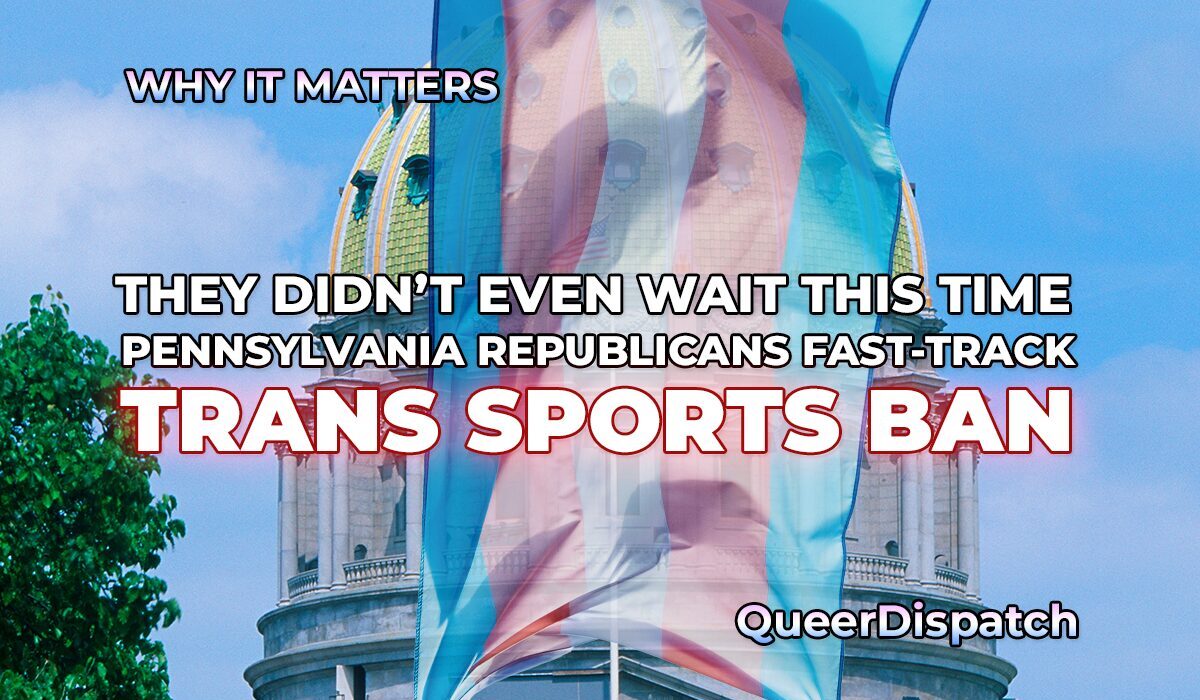
Pennsylvania Republicans fast-track a trans sports ban—again
It didn’t come with warning.
No public memo. No heads-up. No time to organize.
Just a bill—reintroduced, renamed, and rushed forward in the Pennsylvania State Senate.
And if you blinked, you missed it.
The Bill Isn’t New. The Speed Is.
The legislation now moving under SB 1293 is not new policy—it’s a repackaged version of last year’s “Save Women’s Sports Act” that already passed the Senate once before.
This time, though, the process looks different.
- Introduced: April 17, 2026
- Committee movement: within days
- First consideration: April 20, 2026
Advocates say what’s missing matters just as much as what’s included:
- No co-sponsorship memo
- No early public comment window
That’s not just procedure. That’s access.
What SB 1293 Actually Does
[Image Placement – girls high school sports]
At its core, SB 1293 is straightforward—and sweeping.
The bill would:
- Require school sports to be classified as:
- Male
- Female
- Co-ed
- Restrict girls’ and women’s teams to students assigned female at birth
- Apply to:
- K–12 public schools
- Public colleges and universities
- Any school competing against public institutions
- Create legal liability, allowing students or schools to sue if they believe they were harmed by a team’s designation
Like similar bills across the country, it defines sex in strictly binary terms—male or female, assigned at birth.
More Stories from QueerDispatch
A Familiar Argument—And a Familiar Rebuttal
Supporters say the bill is about fairness.
They argue it:
- Protects competitive balance
- Preserves opportunities under Title IX
- Addresses perceived physical advantages
But critics say we’ve heard this before—and not just in Pennsylvania.
When the International Olympic Committee moved to restrict transgender participation, Olympic runner Nikki Hiltz called it something simple:
“A solution in search of a problem.”
That phrase has followed this debate ever since.
The Question No One Is Answering
Is this another “solution in search of a problem”?
We’ve heard that phrase before—most recently from Olympic athlete Nikki Hiltz responding to international restrictions on transgender athletes.
That’s not just rhetoric—it’s a challenge:
- Where are the documented cases in Pennsylvania?
- What problem is urgent enough to bypass normal process?
- And why now?
Lawmakers pushing the bill haven’t pointed to a specific statewide crisis.
But they have moved quickly.
What Opponents Say
Opponents don’t see fairness.
They see targeting.
Civil rights groups argue the bill:
- Excludes transgender girls entirely from school sports
- Overrides existing policies from athletic organizations
- Increases stigma for an already vulnerable group
They also point to research showing that transgender youth who experience discrimination face significantly higher risks of mental health challenges.
We’ve Been Here Before
In 2022, a nearly identical bill made it through the legislature.
It didn’t survive the governor’s desk.
Now, it’s back.
Same framework. Same outcome being pursued.
Just faster.
What Happens Next
SB 1293 has already:
- Cleared committee
- Reached first consideration
From here, it could:
- Advance through additional Senate votes
- Move to the House
- Land on the governor’s desk—again
Why This Matters
Because this isn’t just about sports.
It’s about:
- Who gets included
- Who gets excluded
- And how quickly those decisions can be made
Without warning.
Without input.
Without time.
The Bottom Line
This bill didn’t come out of nowhere.
But the way it moved?
That’s new.
And for a lot of people watching it unfold, that’s the part that feels the most dangerous.
Find your Pennsylvania State Senator and make your voice heard:
https://www.palegis.us/find-my-legislator
Read More
- Appeals Court Blocks Trump Administration’s ‘Gender Ideology’ Conditions on Local Grants
- New Mexico Says It Will Use State Money to Keep Gender-Affirming Care Available to Trans Youth
- Appeals Court Upholds Hamtramck’s Pride-Flag Ban, Calling City Flagpoles Government Speech
- What If Staying Stops Feeling Safe? The Fear of Being Trans in America