For years, Republicans insisted bills targeting transgender students were about “local control.” State by state, school district by school district, they pushed policies banning discussions of gender identity, forcing teachers to out students, and threatening educators who acknowledged transgender people even exist.
Now they want to take it national.
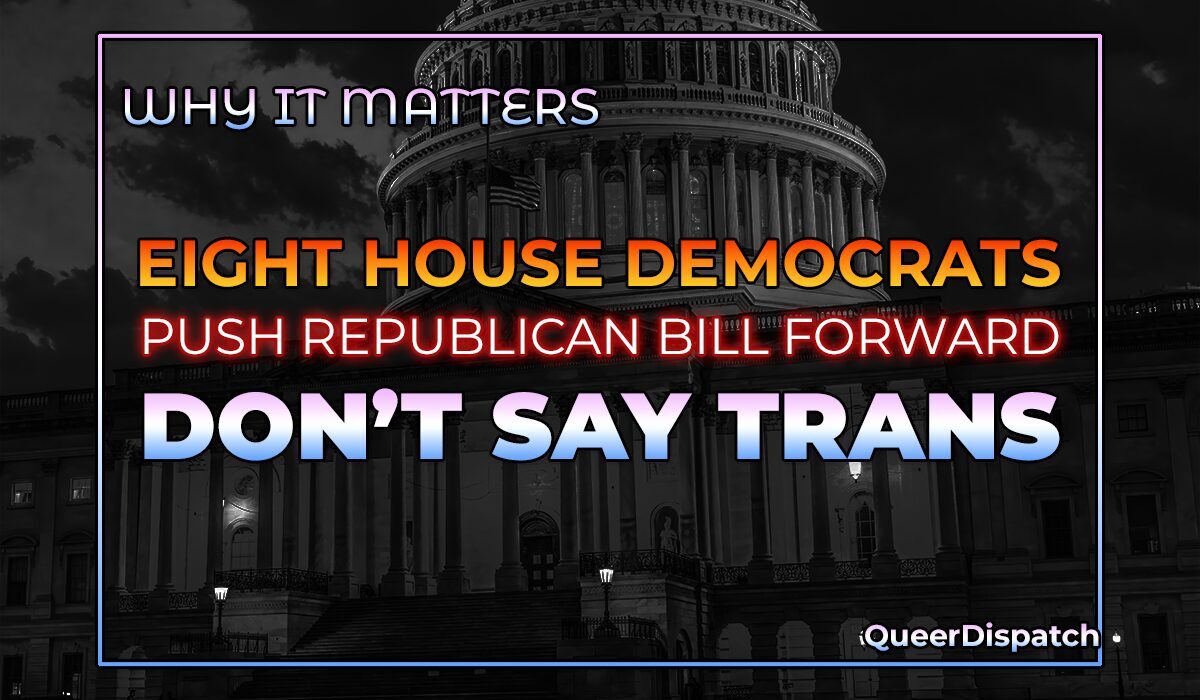
And this week, eight House Democrats helped them do it.
The U.S. House passed H.R. 2616 — a sweeping federal education bill critics are calling a nationwide “Don’t Say Trans” law — in a 217-198 vote that saw every Republican present vote yes alongside eight Democrats. The legislation would force schools to obtain parental permission before recognizing a student’s gender identity at school and would prohibit federal education funds from supporting what Republicans broadly label “gender ideology.” (newsfromthestates.com)
The Democrats who crossed the aisle were:
- Henry Cuellar
- Don Davis
- Cleo Fields
- Laura Gillen
- Vicente González
- Marcy Kaptur
- Marie Gluesenkamp Perez
- Eugene Vindman
LGBTQ+ advocates say the bill’s language is intentionally broad and mirrors the exact framework used in state-level “Don’t Say Gay” and “forced outing” laws already challenged across the country.
And the reason those laws faced fierce resistance is simple: people saw what happened after they passed.
In Florida, the original “Don’t Say Gay” law — officially the Parental Rights in Education Act — exploded into national controversy after teachers reported removing safe-space stickers, classroom books, and even avoiding mentioning same-sex spouses for fear of lawsuits or disciplinary action. Critics warned the vague language created a chilling effect far beyond the bill’s stated scope. Those fears became reality as Florida later expanded the restrictions to apply through high school grades. (AP News)
In Iowa, educators described similar confusion and fear after lawmakers enacted restrictions on LGBTQ+ discussions and required schools to notify parents if students requested different pronouns or names. Teachers reported pulling books from shelves preemptively and districts struggled to interpret what could legally be discussed in classrooms. (PBS NewsHour)
In several states, parents of transgender children, civil rights organizations, and even students themselves pushed back legally, arguing that forced outing policies place vulnerable youth in danger. Medical and mental health organizations have repeatedly warned that forcibly outing transgender minors can increase risks of depression, homelessness, self-harm, and abuse. (American Academy of Pediatrics)
That context matters because Republicans are no longer testing these policies at the state level. They are attempting to normalize them federally.
The bill’s supporters continue to frame the legislation as a “parental rights” issue. But opponents argue that framing deliberately ignores the students most at risk — especially transgender youth living in hostile households where disclosure may not be safe.
More Stories from QueerDispatch
Critics also point out the contradiction at the center of the movement itself.
The same political figures who spent years condemning “federal overreach” are now openly attempting to use federal funding as leverage to control what teachers, counselors, and schools can say about transgender people nationwide.
Congressional Equality Caucus Chair Mark Takano condemned the legislation as part of a broader effort to “legislate transgender people out of public life.” (advocate.com)
The ACLU warned the measure would endanger vulnerable students and create an atmosphere of fear inside schools. (advocate.com)
And LGBTQ+ advocates are increasingly frustrated not just with Republicans, but with Democrats willing to compromise on transgender rights whenever political pressure rises.
Because this is no longer about one state legislature in Florida or Iowa or Tennessee.
This is about whether transgender students are allowed to exist openly in public education anywhere in the United States.
Read More
- Appeals Court Blocks Trump Administration’s ‘Gender Ideology’ Conditions on Local Grants
- Ohio Billboard Claiming ‘No Child Has Two Moms or Two Dads’ Sparks Backlash—And a Wave of Support for LGBTQ+ Families
- New Mexico Says It Will Use State Money to Keep Gender-Affirming Care Available to Trans Youth
- What If Staying Stops Feeling Safe? The Fear of Being Trans in America