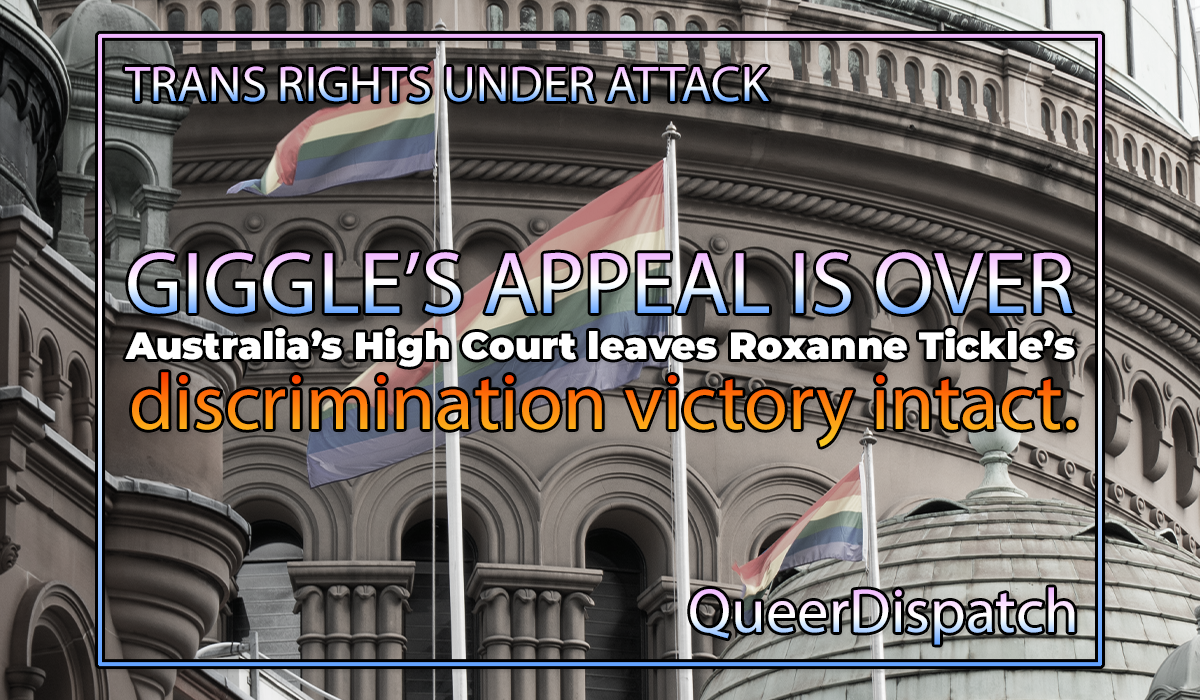
Australia’s highest court has refused to hear Giggle for Girls’ final appeal. That leaves in place a landmark ruling that found Roxanne Tickle was unlawfully discriminated against because she is transgender.
Australia’s High Court refused Giggle for Girls and founder Sall Grover special leave to appeal the case.
The decision brings the long-running legal fight to an end.
The Full Federal Court’s ruling now stands. That court found that Tickle, a transgender woman, experienced direct gender-identity discrimination when Giggle removed her from its women-only social networking app and refused to let her return.
The High Court’s decision was brief.
Its impact is not.
The court said there was no reason to doubt the Full Court’s interpretation of the relevant parts of Australia’s Sex Discrimination Act 1984. It also found that the proposed appeal did not have enough chance of success to justify another hearing.
Special leave was refused with costs.
That leaves the Full Federal Court’s May ruling intact. It also leaves Tickle’s $20,000 damages award in place.
A final attempt to overturn the ruling
Tickle joined Giggle for Girls in 2021.
The app marketed itself as a social network for women. Prospective users were required to submit a selfie.
Tickle passed the app’s screening process and was given access.
She was later removed after Grover personally reviewed her photograph.
More Stories from QueerDispatch
Tickle asked to be allowed back onto the platform. Giggle refused.
She then filed a discrimination complaint.
In 2024, a Federal Court judge ruled that Giggle and Grover had unlawfully discriminated against her. The court initially treated that discrimination as indirect and awarded Tickle $10,000.
Giggle and Grover appealed.
Tickle also appealed parts of the ruling.
That ultimately made the judgment against Giggle stronger.
In May 2026, a three-judge Full Federal Court rejected Giggle’s appeal. It also sided with Tickle on her cross-appeal.
The court found that two acts amounted to direct gender-identity discrimination. Those acts were removing Tickle from the service and refusing to let her return.
The court also increased her damages to $20,000.
Grover and Giggle then turned to Australia’s High Court.
The High Court has now refused to hear the case.
What the courts actually decided
The case focused on how Australia’s federal discrimination law protects transgender and gender-diverse people.
Australia’s Sex Discrimination Act protects people from discrimination based on gender identity.
The law’s definition of gender identity also includes gender-related characteristics. Those can include appearance.
The Full Federal Court found that Tickle was excluded because of characteristics connected to her gender identity.
That was direct discrimination.
Giggle also argued that the app should qualify as a “special measure” intended to advance equality for women.
The Full Federal Court rejected that argument.
The court found that the special-measures provision could not be used to justify discrimination based on a separate protected characteristic.
That issue was central to Giggle’s attempt to reach the High Court.
The High Court said there was no reason to doubt the Full Court’s interpretation.
What the High Court did — and did not — decide
The High Court did not hold a full appeal.
It also did not issue a broad new ruling about every women-only service or space in Australia.
Giggle first needed permission, known as “special leave,” to bring the appeal.
The High Court refused that permission.
That distinction matters.
The High Court did not replace the Full Federal Court’s decision with a new judgment. Instead, it decided that Giggle’s proposed challenge did not have enough prospect of success to justify an appeal.
For this case, however, the result is final.
There is no higher Australian court for Giggle to appeal to.
The Full Federal Court’s decision remains in force.
Australia’s discrimination laws also contain exceptions and exemptions that can apply in specific circumstances.
That means Tickle v. Giggle should not be read as a rule governing every single-sex or gender-specific setting.
But the ruling still carries significant weight.
A service cannot simply decide that a transgender woman is “really” a man and assume that discrimination law no longer applies.
A case that became much bigger than an app
The dispute began with one woman being removed from one social platform.
It became a major test of Australia’s protections against gender-identity discrimination.
Those federal protections were added to the Sex Discrimination Act in 2013. They cover sexual orientation, gender identity and intersex status.
Throughout the case, Grover framed the dispute as a conflict between women’s rights and transgender rights.
The courts did not accept that framing as a way around the law.
Trans women are women. The legal question was not whether one group of women should lose protections so another group could gain them.
The question was whether a service could exclude someone because of a protected characteristic.
The Full Federal Court said it could not.
That matters beyond this case.
Anti-trans campaigns often describe equality as a zero-sum fight. They suggest that recognising transgender people must take rights away from someone else.
Tickle v. Giggle shows a different legal reality.
Anti-discrimination law exists to protect people from unequal treatment based on protected characteristics.
Roxanne Tickle was excluded because of characteristics tied to her gender identity.
The Full Federal Court found that unlawful.
Australia’s High Court has now declined the final attempt to overturn that finding.
For Tickle, the case is effectively over.
For transgender Australians, an important discrimination ruling remains standing.
Read More
- Hungary Moves to Undo Anti-LGBTQ+ ‘Propaganda’ Rules as Turkey Detains 150 Protesters
- Appeals Court Upholds Hamtramck’s Pride-Flag Ban, Calling City Flagpoles Government Speech
- LGBTQ+ Youth Crisis Services Return to 988 — But Questions Remain for Trans Youth
- What If Staying Stops Feeling Safe? The Fear of Being Trans in America